




We use cookies on this site to enhance your experience.
By selecting “Accept” and continuing to use this website, you consent to the use of cookies.

Sept. 28, 2026
Print | PDFA new study from the Laurier Centre for Women in Science (WinS) found that women accounted for less than one third of published authors in a sweeping sample of Canadian scientific journals. Notably, the percentage of women submitting manuscripts generally matched those published, suggesting that broader workforce disparities may play a larger role than publication bias.
The authors of the “Balancing the byline” study analyzed more than 67,000 articles submitted to Canada’s biggest publisher of international science journals, Canadian Science Publishing (CSP), between 2010 and 2021. It is the first-ever large-scale analysis of gender representation in Canadian science, technology, engineering and mathematics (STEM) journals.
“I expected to see a difference between the proportion of women submitting and women being accepted, and we didn’t find that,” says lead author Eden Hennessey, WinS research and programs director and Wilfrid Laurier University’s equity, diversity and inclusion data specialist. “It turns out there aren’t enough women submitting their work for publication in the first place, so it’s a more complex issue because we can’t just point toward a journal and problematic peer review processes. It’s a much larger, sociocultural phenomenon of imbalanced gender representation in STEM fields.”
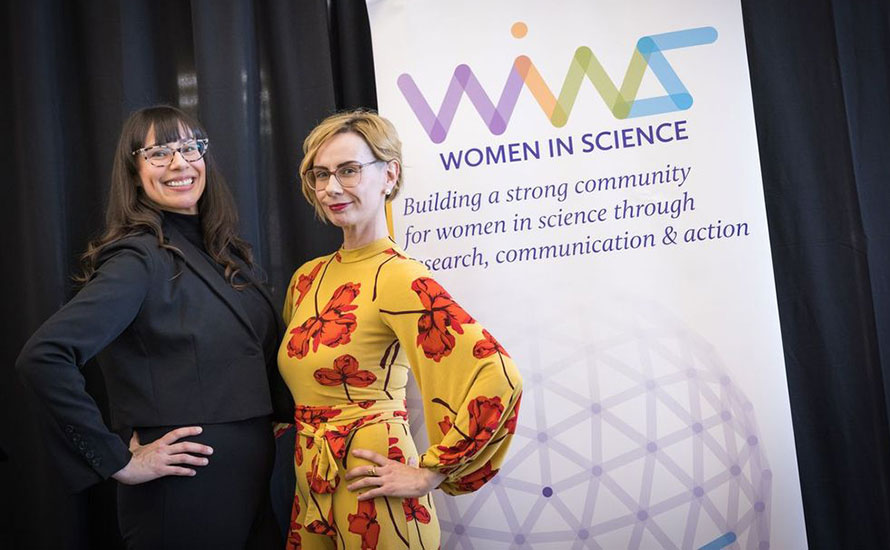
Eden Hennessey (left) and co-author Skye Hennessey, WinS project manager
Below, Hennessey reflects on the study’s key findings and recommendations for tackling gender inequity.
Women authored a higher percentage of publications within biomedical sciences, multidisciplinary sciences and biological sciences. In contrast, lower percentages were observed in engineering and physical sciences, a pattern that aligns with the underrepresentation of women in these fields.
“The evidence is pretty clear that we are not seeing gains in representation equivalent to the investments we’ve been making,” says Hennessey. “Even with federal programs, camps and workshops, we’re seeing diminishing representation in certain fields for women. In computer science, for example, we’ve seen a slight dip. Engineering and math remain low. On the other hand, we have achieved parity in biology. So, it’s important to talk about sub-disciplines when we discuss authorship, as we’ve done in this paper. It’s also important to note that representation is only one facet of equity. Presence alone does not imply inclusion.”
This figure was generally higher in the physical sciences. In the Canadian Journal of Physics, solo-woman authors accounted for 5% of all publications. This deviation suggests that in certain fields, such as physics, individual women researchers have carved out niches, enabling them to produce solo publications.
“However, our analysis was consistent with broader studies showing that few people publish solo at all, and I think that’s an important note in this work,” says Hennessey. “Science remains a team sport and we are seeing more collaboration than ever.”
"I think we should all be looking at our own spheres of control. What can I be doing in my own lab to open doors and expand who is getting opportunities?”
“At the start of a research career, authorship order is critical,” says Hennessey. “Being a prominent author on a publication opens doors, leads to funding opportunities and makes you viable on the tenure track. There are disciplinary differences in author order. In physics, for example, last author is the most prestigious, whereas in my field of social psychology you want first position.
"As a mid-career researcher, it doesn’t hurt me at all to include the contributions of early-career researchers in publications, but it helps them immensely. I think we should all be looking at our own spheres of control. What can I be doing in my own lab to open doors and expand who is getting opportunities?”
“We know that if women are represented as authors, the science changes,” says Hennessey. “We recently hosted Vincent Larivière at Laurier, who is arguably one of the best scholars in this area. He has data showing that we research what we care about. We research what’s relevant to our communities and our identities.”
“Just because we didn’t find a publication bias in one study doesn’t mean there aren’t any, so we are continuing to work with publishers and reviewers in that ecosystem to understand processes and how they affect people,” says Hennessey. “We are going to do more qualitative work. Using whether or not a paper was accepted as an indicator of bias doesn’t tell us how an editor or peer reviewer engaged with an author, or the type of feedback they received. Our work for this paper was based on metrics, but behind every single data point is a human being.”
“Our work is a call to action, both for individuals and institutions,” says Hennessey. “Who are we inviting onto research projects and grant applications? I encourage all researchers to check out the federal government’s Gender-based Analysis Plus course.
“Inclusion must also be structural. We have learned that it’s not just about bolstering a little girl’s confidence to go into STEM. If they walk into a situation where they’re experiencing discrimination or ostracism, we’ve encouraged them to enter a house we know is burning. To quote Shohini Ghose, we need to fix systems, not women. Our work is focused on providing metrics that can be used for policy and resource creation. We need accountability measures and practical processes for reporting harm and bias so it’s possible for people to confront prejudice in a safe way.
“This isn’t a problem that’s going to self-correct, so we need intervention at multiple levels.”