

We use cookies on this site to enhance your experience.
By selecting “Accept” and continuing to use this website, you consent to the use of cookies.
Oct. 13, 2026
Print | PDFGraduating student Delta Collard grew up in a one-road Ontario town and had never flown on an airplane. When she crosses the stage at Wilfrid Laurier University’s fall convocation on Friday, she’ll accept a degree in International Education Studies, counting hands-on learning opportunities gained in Costa Rica, Hong Kong, Beijing and Egypt among her university experiences — and it all began after a chance encounter with a Laurier student when she was in high school.
Collard is from the small farming community of Frome, Ontario. A one-lane highway bisects the town, and passenger vehicles share the road with tractors.
Growing up, she excelled at math and science and had planned to pursue engineering at university.
“A Laurier student started working in my mother’s restaurant one summer,” says Collard. “They had just returned from a third-year international placement and spoke highly of the experience and the program. I had never traveled anywhere before and thought that this might be an interesting opportunity.”
Initially, her father was concerned with the pivot away from engineering but supported her decision.
“He told me to go see the world,” she says. “And to do all the things that he never got to do.”
A job teaching English in Hong Kong the summer after her first year at Laurier led to a lot of firsts for Collard: her first time on an airplane, her first time using public transit, and her first time navigating language barriers.
“I’ve always been independent and able to figure things out on my own,” says Collard. “But being alone in a different country was a big adjustment. I just had to learn to be open to things being different.”
Collard’s summer of firsts was followed by a two-week, faculty-led field course in Costa Rica, where students examined international development, sustainability and climate change while travelling the country and engaging with communities working on these issues. She also spent two weeks in Beijing, China studying language and culture at Beijing Normal University, returning with a foundational understanding of Mandarin.
While at Laurier, Collard was inspired by a fateful meeting once again when a fellow student named Rahima Khushi spoke to Collard’s class about growing up in the largest refugee camp in the world — Cox’s bazaar refugee camp in Bangladesh.
Khushi is a scholar in the International Students Overcoming War (ISOW) program, a Laurier student-founded and funded scholarship that supports scholars from conflict-affected regions to pursue an education in Canada.
“Rahima spoke about her experiences and how she ended up at Laurier, and I was astounded,” Collard says. “I felt like there were things that I could do to make a big difference in someone's life, so I decided to join ISOW.”
In her role as the assistant director of scholarships, Collard met ISOW scholar candidates from all over the world. She also advocated for increased access, representation, and equity in education to Canadian officials in Ottawa.
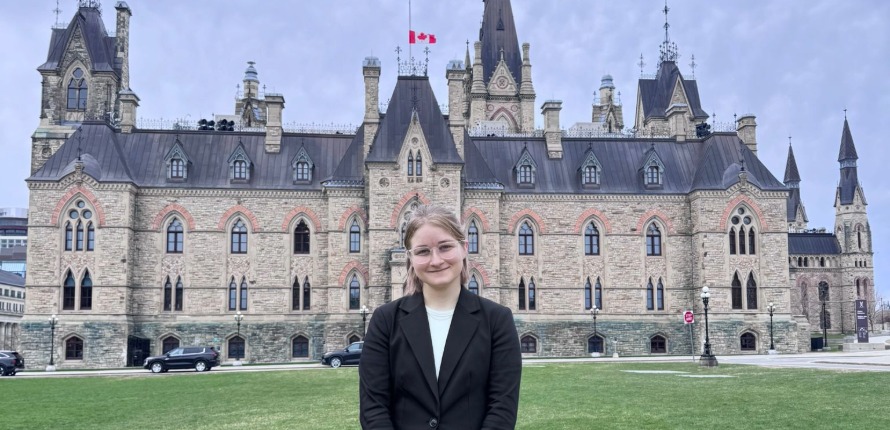
“She was really committed to fostering good, strong relationships with the scholars,” says Gavin Brockett, associate professor and ISOW faculty advisor. “It’s a skill that’s important for us. If we understand the context and environment the scholars come from, we can support them better.”
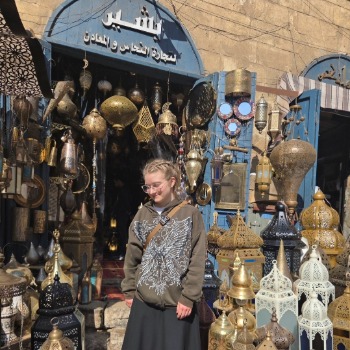
In February 2026, Collard and another student accompanied Brockett to Cairo for a directed studies course. They worked with humanitarian organizations that provide aid in Gaza and support more than 100,000 Palestinian refugees in Egypt. Two of those refugees are incoming ISOW scholars who are waiting for permits to study at Laurier.
“We were invited into one of the scholar’s homes and made to feel so welcome,” says Collard. “It was very much a taste of Arab culture and hospitality.”
The trio met with Canadian officials in Cairo to draw attention to the delays in securing visas for the ISOW scholars. The issue is still awaiting resolution.
“It’s important for the students to have a bit of a reality check and understand that governments have competing priorities.” says Brockett. “A situation that we may think is easily resolved, isn’t. This is the reality of humanitarian work.”
In the fall, Collard will begin a master’s in Global Justice, Religion and Culture at Laurier and will serve as ISOW president.
“Engaging with scholars, humanitarian organizations, and governments showed me how education intersects with migration, policy, and global advocacy,” she says. “These experiences have strengthened my commitment to equitable education both locally and globally.”
“Delta exemplifies leadership, academic excellence and the impact of experiential learning — all the things we want our students to have,” says Brockett. “She is somebody that Laurier can be proud of.”