

We use cookies on this site to enhance your experience.
By selecting “Accept” and continuing to use this website, you consent to the use of cookies.
Nov. 11, 2026
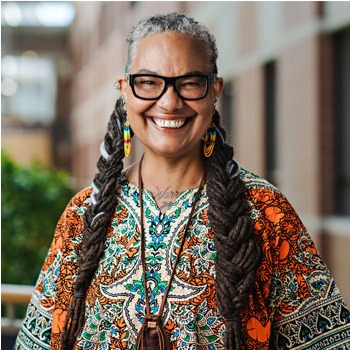
Print | PDFToo often, social and academic research conducted in Black, Indigenous and Afro-Indigenous communities focuses on trauma and inequity. The Wele’g Dwennimmen Roots of Survivance Institute, created by Wilfrid Laurier University researcher and assistant professor Ann Marie Beals, takes a different approach: it aims to benefit Black, Indigenous and Afro-Indigenous communities by focusing on research, traditional knowledge and ways of being that have historically been minimized.
Beals, who is Two-Spirit Afro-Indigenous L’nu’k from the territory of Mi’kma’ki, created the institute to bring together their intertwined Indigenous roots and address how their communities have been defined by colonizers.
“It was important to me to create a place where our communities are not simply studied but are recognized as people who hold knowledge about our own lives, our own communities, and what we need to be well and thrive,” says Beals.
Wele’g, which is Mi’kmaq for living well, is at the heart of the institute’s aim to improve the lives of Afro-Indigenous people. Dwennimmen, the Adinkra symbol of the ram’s horns, from the West Coast of Africa, which sits at the centre of the institute’s logo, represents the dual role of strength and humility in the pursuit of knowledge.
The Wele'g Dwennimmen Roots of Survivance Institute emphasizes survivance, a concept rooted in the work of Anishinaabe scholar and writer Gerald Vizenor that focuses on the ongoing presence, knowledge, creativity and resilience of Indigenous Peoples.
Survivance says, we are here, and we have always been more than what has happened to us. - Ann Marie Beals
Research at the institute spans themes of survivance, community well-being and climate justice. One major project currently underway is I Am Water, a feature-length documentary that follows Lila Bruyere, an Anishinaabe Elder and residential school survivor, as she explores themes of family, healing, land and intergenerational knowledge.
The institute aims to create greater visibility for Afro-Indigenous Peoples, whose experiences are frequently overlooked when Black and Indigenous identities are treated separately. Beals is expanding Proclaiming Our Roots, a community-based research initiative led by Dr. Ciann Wilson that originally launched in 2017. The initiative examines Afro-Indigenous histories, identities and experiences and develops elementary, secondary and post-secondary curriculum and community-based educational resources.
In January 2026, a Wele'g Dwennimmen Roots of Survivance Symposium brought together Elders, Knowledge Keepers, scholars, youth and community leaders at Laurier’s Waterloo campus. Discussions at the symposium are now shaping research at the institute, including an exploration of food security and community garden accessibility in local communities.
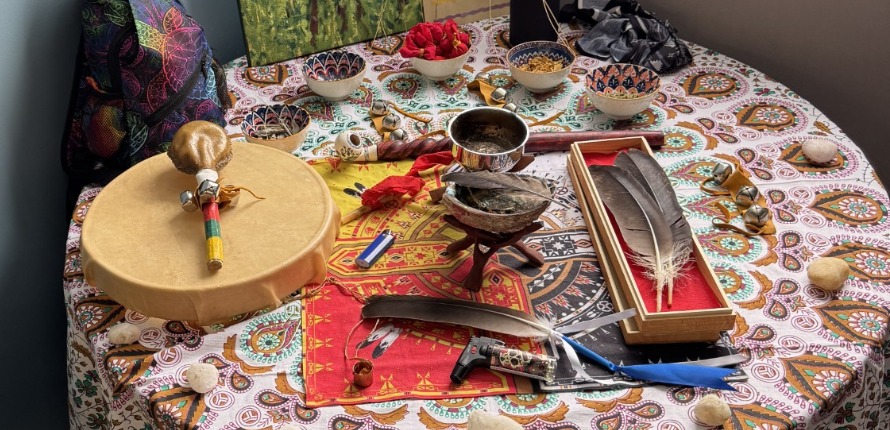
A medicine table set up for participants of the Wele'g Dwennimmen Roots of Survivance Symposium
"We cannot separate the health of people from the health of the land," says Beals, noting that Indigenous communities have long maintained relationships with land-based knowledge systems despite centuries of colonial disruption.
Looking toward the future, Beals encourages Laurier students and community members to get involved with the institute through research projects, events and community-based initiatives. They can reach out to weleg@wlu.ca to get involved.
"There is a belief that communities need more research," says Beals. "What communities are telling us is that they need research that matters to them, respects their knowledge and leaves something useful behind."