

We use cookies on this site to enhance your experience.
By selecting “Accept” and continuing to use this website, you consent to the use of cookies.
July 22, 2026
Print | PDFWilfrid Laurier University students Gabriel Lockstone, Lucas Coulson and Zach Gould are embracing the opportunities presented by generative AI (gen AI) and applying their in-class knowledge to real-world problems.
The trio has created Detectabli, a business intelligence platform that helps organizations improve how they appear in gen AI search results, which are quickly replacing traditional web searches.
“Detectabli helps frame your company in a way that AI can see, understand and accurately speak about your company in search results,” says Lockstone. “This is a new problem that a lot of companies haven’t solved.”
The AI enhanced answers that are generated following a web search are changing user behaviour, often removing the need to click through to a web page. Many organizations are struggling to influence how their information is presented.
“AI is providing opportunities for people to create solutions to problems that they couldn’t before. People who are building AI skills are at an advantage, because once you understand the basics the possibilities are endless.” – Gabriel Lockstone
Lockstone, a third-year Economics student, chose Laurier because of the strength and reputation of the Lazaridis School of Business and Economics and its co-op program. During a co-op work term on the mergers and acquisitions team at Constellation Software, Lockstone was using gen AI to conduct research and became frustrated by misinformation in AI search results. This was his light bulb moment and the origin of Detectabli.
He met Coulson and Gould when they played on the same intramural volleyball team and discovered a shared interest in gen AI.
“The sparks were just flying,” says Lockstone. “And we decided, ‘Okay, we’re working on something together.’”
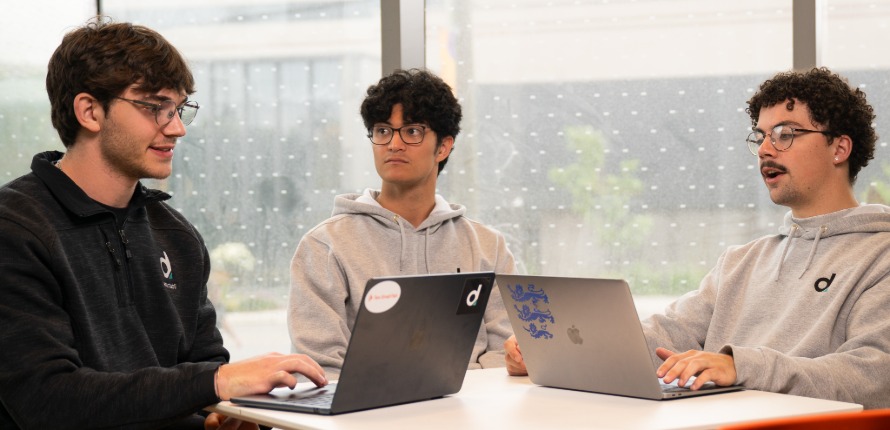
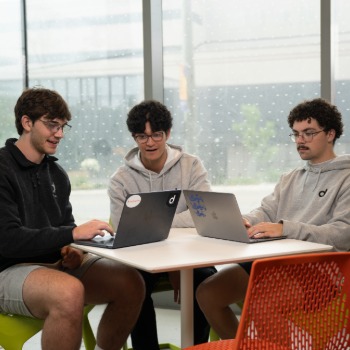
From left: Gabriel Lockstone, Lucas Coulson and Zach Gould.
In February 2026, the trio was accepted into the Laurier Startup Lab, an early-stage incubator that provides mentorship and connection to students, alumni and community members on Laurier’s Waterloo, Brantford and Milton campuses. Entrepreneurs are guided through a year-long process in four phases – discovery, ideation, building and growth – with the goal of turning their ideas into viable businesses.
“I've never seen the mentor group sit up and take notice like they did for Detectabli,” says Nancy Campbell, founder of 10Marketing Consulting and one of Detectabli’s mentors. “What impressed us was their product, but more so I would say the three of them. They have a maturity and thoughtfulness beyond their chronological years.”
Campbell spent much of her career in senior leadership roles at business-to-business companies including Manulife and is helping Detectabli with go-to-market strategies. With so much interest from the mentor group, Detectabli was assigned three additional mentors to help accelerate the business with both technical and marketing strategies.
Gould, a fourth-year Computer Science student, has taken full advantage of the mentorship opportunities.
“I’m in awe of the knowledge our mentors have,” he says. “We could ask them questions for days and they’ll have answers for every single one of them.”
Coulson, a third-year Economics student, credits the StartUp Lab ecosystem for the founders’ strong business partnership.
“Joining the StartUp Lab was one of the best decisions we’ve ever made,” says Coulson. “I've gained so much knowledge and built connections with other founders. Our conversations are so inspiring.”
Detectabli is already experiencing early success, with its first client seeing a 200% increase in AI search traffic in just two months.
Lockstone, Coulson and Gould are laser focused on improving their product with the goal of eventually turning it into a global leader in AI visibility.
“We’re very fortunate that there’s three of us on the team,” says Lockstone. “We have the ability to shift workloads when one of us is overwhelmed with coursework, so we can keep pushing forward.”