


We use cookies on this site to enhance your experience.
By selecting “Accept” and continuing to use this website, you consent to the use of cookies.
Aug. 6, 2026
Print | PDFThis year marks the 50th anniversary of the Community Psychology program at Wilfrid Laurier University, the largest English‑language program of its kind in Canada.
Community psychology focuses on research, evaluation and action to improve conditions in communities – from mental health care organizations to First Nations – that may influence individual health and well-being. Practitioners often work closely with communities on their self-identified needs, relying on both research evidence and community expertise to address ongoing challenges.
At Laurier, undergraduate students can acquire a minor or specialization in Community Psychology. Alongside seven dedicated faculty members, students gain experience working with mental health, social services and health-care organizations to enhance their program and evaluation capacity.
“One of the things I most value about community psychology is its recognition that knowledge is not created in isolation,” says Richelle Monaghan, dean of Laurier’s Faculty of Science. “For 50 years, the program at Laurier has fostered meaningful partnerships between the university and communities, demonstrating how research and practice can work together to create positive change. At a time when communities are navigating increasingly complex social challenges, the values and practices of community psychology are more relevant than ever.”
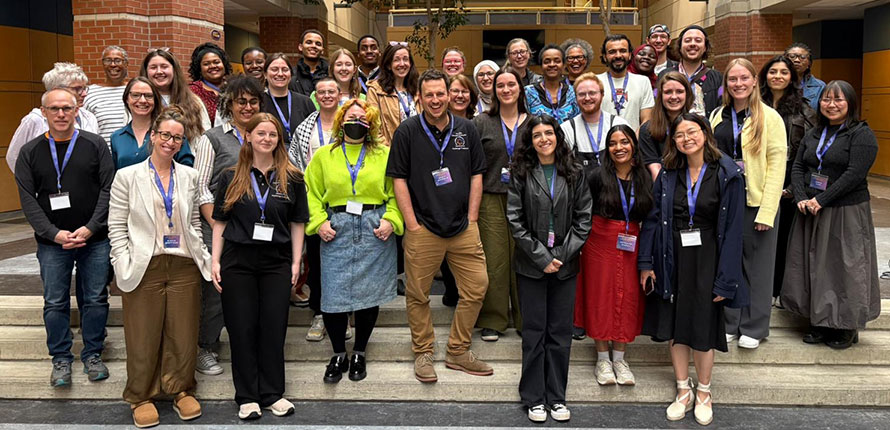 Attendees and members of the organizing committee for the 2026 Canadian Community Psychology Conference at Laurier.
Ciann L. Wilson, associate professor and program coordinator, says Laurier’s Community Psychology program stands out for its unique mix of practical and theoretical learning.
“Community Psychology at Laurier offers students thorough training in quantitative and qualitative research methods, as well as program evaluation, all contextualized within a social justice framework,” says Wilson, the Canada Research Chair in Community-Based Research, Ethics and Well-Being. “We help students reimagine the ways research can be used as a tool for positive social change.”
“We help students reimagine the ways research can be used as a tool for positive social change.”
This year also marks 50 years since community psychology was formalized as a discipline in Canada. To celebrate both anniversaries, Laurier hosted the Canadian Community Psychology Conference in May. More than 180 academics, students, practitioners and community partners travelled from across North America, the Caribbean and Africa to Laurier’s Waterloo campus for the three-day event.
Attendees participated in workshops, watched presentations and engaged with community organizations. Keynote discussions included a panel of founding leaders in community psychology reflecting on the history of the field and sharing advice for emerging community psychologists. An alumni panel highlighted the impact of Community Psychology graduates in their communities and workplaces. Two collaborative town hall sessions invited participants to discuss strategies and next steps for reinvigorating a Canadian community psychology network.
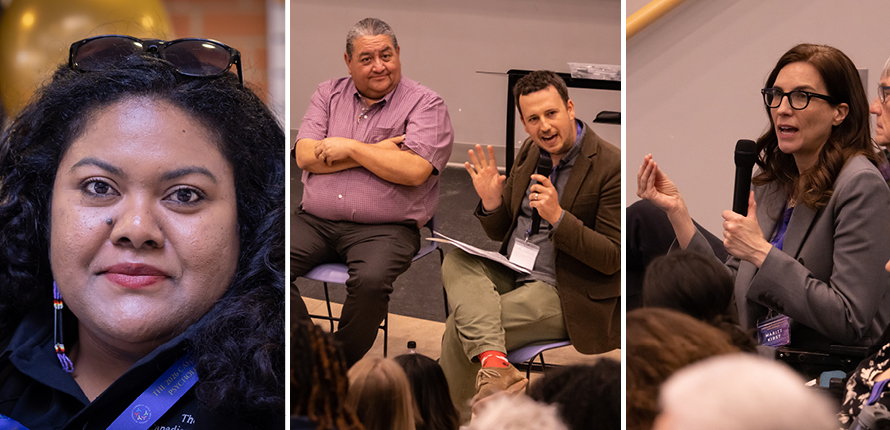
Moments captured at the 2026 Canadian Community Psychology Conference. Laurier participants included Associate Professor Ciann Wilson (left), Associate Vice-President: Indigenous Initiatives Darren Thomas (centre left) and Associate Professor Maritt Kirst (right).
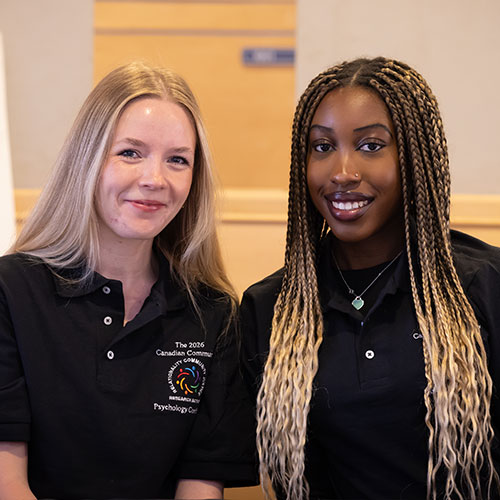
Laurier undergraduate and graduate volunteers played important roles throughout the conference, assisting with accessibility services, timekeeping, registration and logistical support.
Building on the momentum of the conference, a special issue of the American Journal of Community Psychology will focus on the contemporary landscape of community psychology while acknowledging 50 years of scholarship. The issue will be guest edited by Laurier’s Wilson, Assistant Professor Alexis Buettgen and Community Psychology PhD student Erin Dekker, along with Leo Wilton from the State University of New York at Binghampton. The editorial team plans to spotlight research and practice that highlights how communities – especially those facing marginalization and structural oppression – cultivate hope, resilience and collective action in response to intersecting crises.