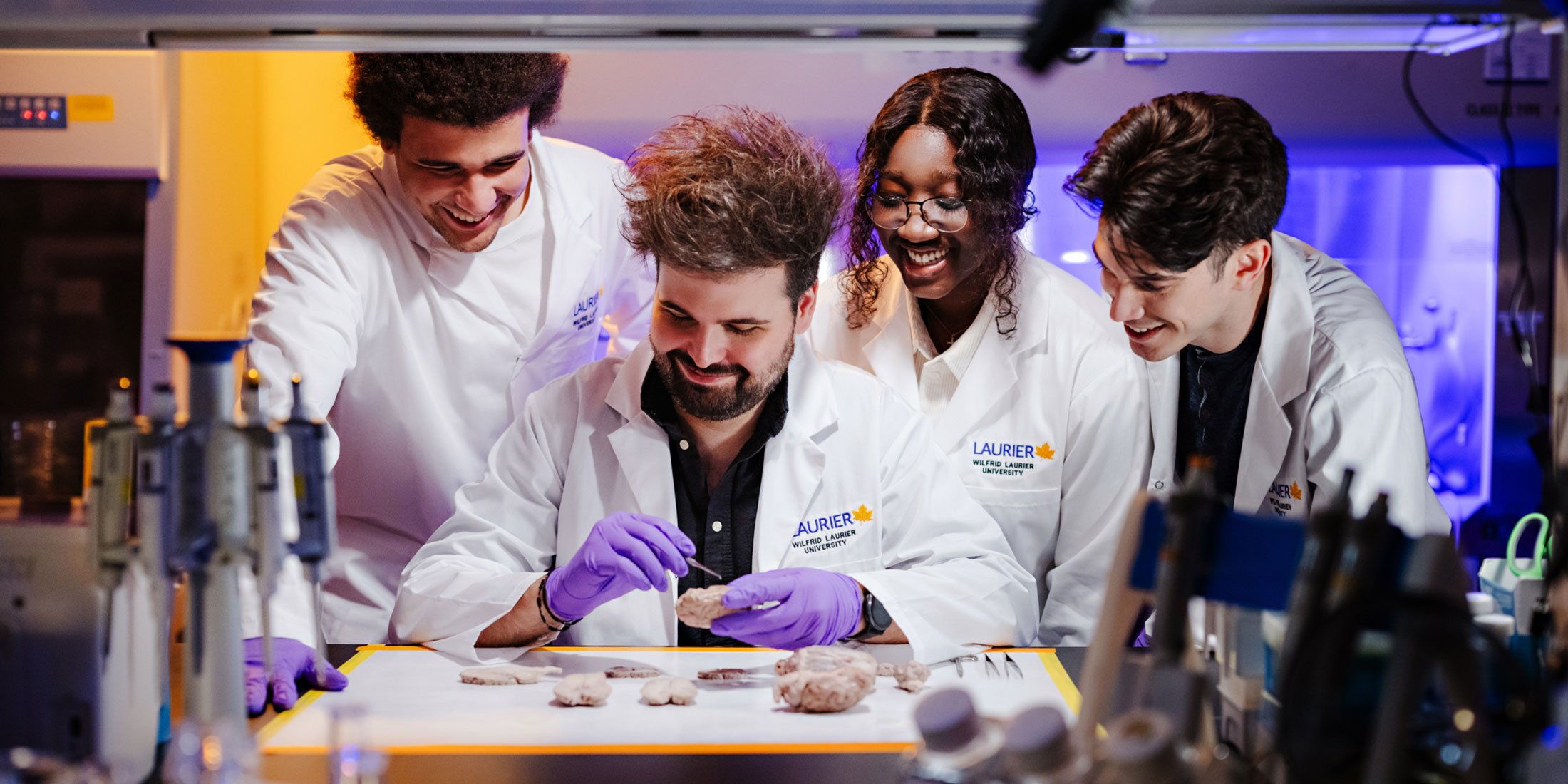
Laurier Physics and Computer Science Professor Shohini Ghose shares why quantum computing is so hard to explain – and what may be in store for the future.
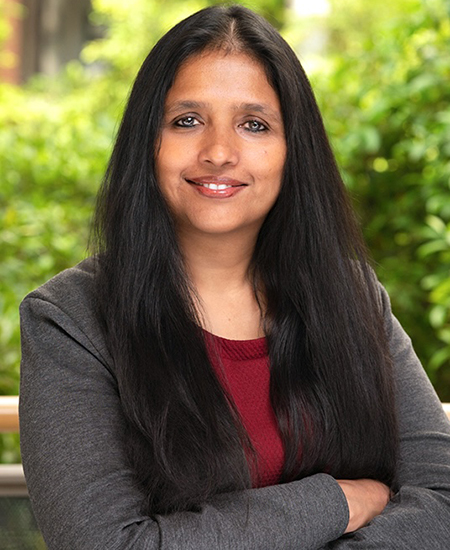 Wilfrid Laurier University’s Shohini Ghose is internationally recognized for her research into how the laws of quantum physics can be harnessed to transform computation, communication and our understanding of the universe. A professor of Physics and Computer Science, Ghose was recently named to UNESCO’s Quantum 100 – a list recognizing global leaders in quantum science – and received the 2025 Trailblazer Award in Policy for Science from the Canadian Science Policy Centre.
An award-winning science communicator, Ghose is the author of Her Space, Her Time: How Trailblazing Women Scientists Decoded the Hidden Universe (2023) and Clues to the Cosmos (2019). She also serves as the Natural Sciences and Engineering Research Council of Canada Chair for Women in Science and Engineering and is a TED Senior Fellow. Below, Ghose discusses quantum computing – an approach that harnesses the laws of quantum mechanics to solve complex problems beyond the reach of classical supercomputers – and why it challenges our most basic assumptions about reality.
The theory itself, quantum theory, is what we call probabilistic. Until quantum theory was developed about 100 years ago, all the other theories we had for understanding our universe were what we call deterministic, meaning given some set of information one can build a model that precisely predicts outcomes. When you drop an object, gravity will predict exactly how it behaves, right? The precision is only limited by how well you can measure that object and gravity. In principle, if you had all the information, everything would be perfectly predictable. It’s the clockwork universe idea.
What quantum theory tells us is that at the level of microscopic particles like electrons and photons, the outcome is not precise. Uncertainty is built into how the universe behaves at that level. That’s a very radical idea because we’re saying nature is not really fixed, that you can’t pin down every single property of an object no matter how hard you try, and that the universe is not perfectly predictable at a fundamental scale. Over many decades, ever since the birth of quantum theory, very smart folks like Einstein, Heisenberg and Schrodinger had debates about it because it questions our understanding of reality.
What we’ve learned is that this built-in uncertainty can be a feature, not a problem. It’s not a bug. You can cleverly manipulate this uncertainty to do information processing tasks. That’s the revolution – we are flipping our perspective to understand the power of uncertainty rather than the problem of uncertainty. But it is still confusing to people because we have to step away from our everyday experience of deterministic reality.
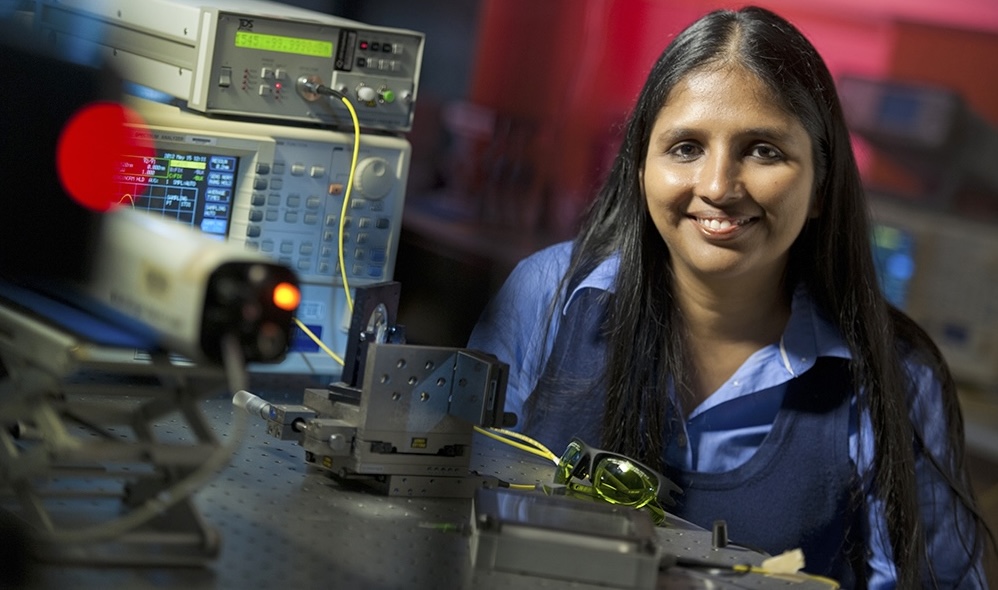
Wilfrid Laurier University Professor Shohini Ghose was recently named to UNESCO’s Quantum 100, a list recognizing global leaders in quantum science.
Quantum computing is not just one more step in building a more powerful computer chip than we currently have. It’s based on revolutionizing the approach to computing itself – the building blocks of how we compute. We used to think that circuits, turning switches on and off, zeros and ones, were the way of computing. Turns out it’s not the only way. We can go beyond that and unlock a larger landscape of computing where we don’t allow just zeros and ones – we allow quantum uncertainty in the probabilities of zeros and ones. That expansion is like adding an extra Lego set of special pieces that allow you to build out your computing toolbox much more efficiently. So that’s really what quantum computing is: it’s about rethinking our model of computing itself.
This is what we call deep tech, meaning it’s early-stage technology. If you think about a computer from the 1960s, at that time the technology was not commercially viable on a large scale. With quantum computing, it’s kind of like that, but I think we’re back in the 1940s, not even in the 1960s. We’re still trying to figure out the right hardware to build and the best platform. If you look back to the history of regular computing, we used vacuum tubes and then the big game changer was transistors and integrated circuits. We don’t quite know: is quantum computing in the vacuum tube era? Because quantum computing is early stage, we’re not commercially at scale yet. I think that will be a few years away, but it’s happening fast because there’s a quantum race right now.
There are various types of quantum computers with different hardware. Companies like IBM and Google are building quantum computers using superconductors. You’ll see pictures of IBM’s quantum computer and it looks like this beautiful golden chandelier. But really the actual computer is a small chip inside that chandelier. The rest is controls and refrigeration because these quantum computers must be operated at very cold temperatures. Other companies, like Xanadu, build quantum computers using particles of light – lasers and components that control light particles – and no extreme cooling is needed. Some of the first quantum processing was done using liquids, where nuclei within molecules in a liquid solvent were used as quantum bits. That was hard to scale, but it’s amazing that our first quantum computers were liquid. Essentially, you’re trying to find a space that you can control. You need to be able to say, ‘I want to control this particular particle to make it do the calculation I want.’ Eventually, maybe we’ll find the one quantum computer that scales – the quantum version of the transistor – but right now that’s not clear.
One is hardware. To build a quantum computer, you have to precisely control individual quantum particles like electrons and photons. That’s very, very difficult. Even a small disturbance causes errors in your computing. So, you have to do error correction. Quantum error correction is a big challenge, especially at scale. On the software side, we know certain kinds of problems where we think we can gain some advantage. But to build an efficient algorithm to simulate any given problem, there’s not a general recipe right now.
Whatever I say now is probably going to be dead wrong, but I will try. Most folks in the quantum space would agree that the initial breakthroughs will be in specific areas, such as understanding the properties of molecules for materials design or building out a new drug. It would be great if you could just calculate what those molecules would do using a quantum computer rather than have to conduct a physical test and wait for clinical trials. Even if you add one extra atom to a molecule, the problem becomes computationally much harder. A molecule is made up of quantum particles. A quantum computer is made up of quantum particles, too. So, it’s more natural to map one quantum system into another quantum system rather than into a regular computer. That’s where I feel there will be real potential – what we call ‘quantum simulation.’
We probably wouldn’t have to change anything on the user side. It’s like with AI. When you want to use ChatGPT, it’s not like you have to learn all about AI. You just use your normal language. Similarly, if you wanted to use a quantum computer, you’d probably just go about it the way you normally do. On the user side, you might not see any difference. The rethinking is on the provider side. Even now, you can log into IBM’s quantum computer and start coding using Python. That translation is what these providers will be doing for us.
“If you think, ‘Wow, this is completely outside of our experience,’ then you’re actually getting it.”
Professor Shohini Ghose
Yes, for sure. Like any technology, you have to know something about it to differentiate between what is hype and what is real. If you expect that quantum will solve every problem and change all of society, that’s wrong. There are always limitations. Just like when AI came along, we all had to learn a bit – what do you trust, what do you not trust? There’s always a learning curve.
All of our current encryption standards for digital security are based on factoring because we know it’s a hard problem. But if somebody built a quantum computer, we know there’s a way for a quantum computer to break our current encryption entirely. So, this is one of the most important things that everybody should be aware of. Like every technology, there’s good and bad. If you can simulate molecules, you can develop drugs, but you can also develop chemical weapons. We need guardrails. You can never actually use quantum or any other technology to protect us from ourselves.
Quantum theory applies to every single particle and energy in the whole universe. That’s why I’ve spent my whole career exploring it. It’s the first theory which forces us to think probabilistically. I had to stop thinking deterministically and think probabilistically. That makes you ask philosophical questions – is this even the right theory? It forces us to constantly question what we really know. It keeps us humble. I constantly feel, ‘Oh my gosh, I think I know it, but wait, no, I’m really confused again. Back to square one.’ It’s fun to not know stuff and have things to discover, but it can also be frustrating.
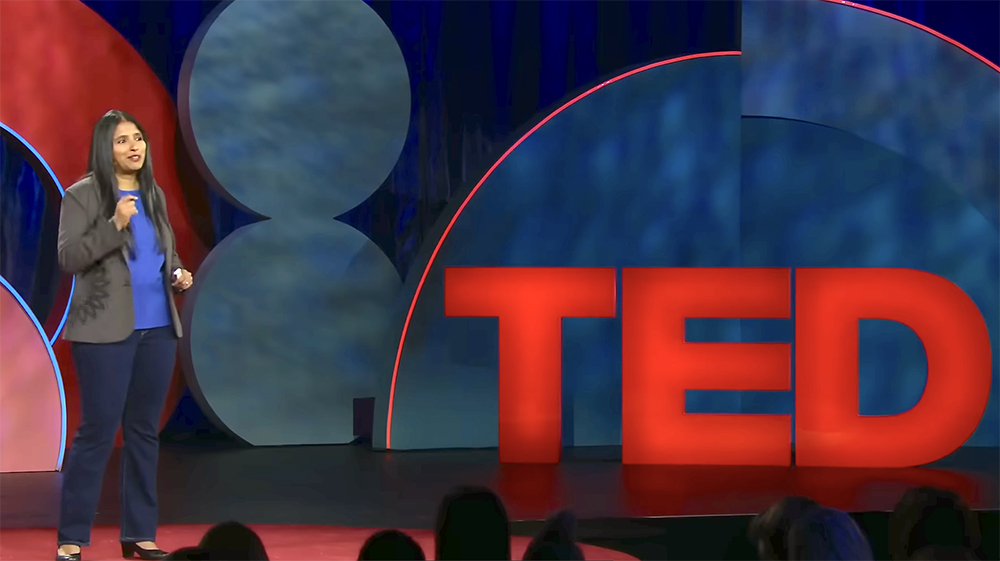
Wilfrid Laurier University Professor Shohini Ghose pictured during her TED Talk “A beginner's guide to quantum computing.”
It is mind-blowing. Head exploding. If quantum computing was like everyday computing, it wouldn’t actually be revolutionary. Something that is revolutionary should make your head explode. If you think, ‘Wow, this is completely outside of our experience,’ then you’re actually getting it. There’s no way for me to give you a perfect analogy because, if I could, we would be back in the classical world, which is not quantum.
Embrace uncertainty, because there’s power to not knowing everything. In quantum, the jargon we use is ‘quantum superposition.’ That is really a way of saying the universe is fundamentally uncertain. You have to consider more than one possibility. Reality is not pinned down to one state. That idea of quantum superposition – that uncertainty is fundamental – is a powerful idea going forward. If I could explain it all to you in 20 minutes or less, that would be great. But I don’t think anybody can. On one hand, it’s very deep and philosophical. On the other hand, it’s very applied. But the underlying questions come from the same idea of uncertainty.