

We use cookies on this site to enhance your experience.
By selecting “Accept” and continuing to use this website, you consent to the use of cookies.
July 24, 2026
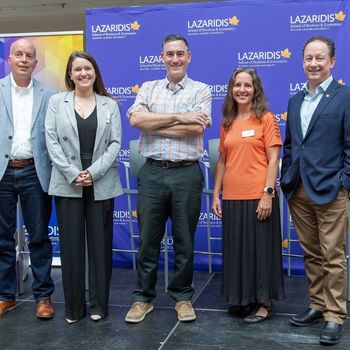
Print | PDFOn June 22, 2026 the Lazaridis School of Business and Economics hosted the second annual Lazaridis Research Day.
Kyle Murray, Dean of the Lazaridis School, started Research Day last year with a focus on bringing together researchers and faculty across areas and departments to present and share ideas further enforcing our strategic priority of amplifying impactful research.
"The key to developing a research culture is making sure we have time and space for researchers,” he said. “In the last 18 months, we've introduced 10 research chairs, seven research awards, and a variety of other initiatives... intended to create that time and space."
Nearly 100 Lazaridis faculty, staff, and students joined in the discussions and presentations throughout the day. The 19 Lazaridis researchers ranged in roles and experience from PhD students to tenured professors.
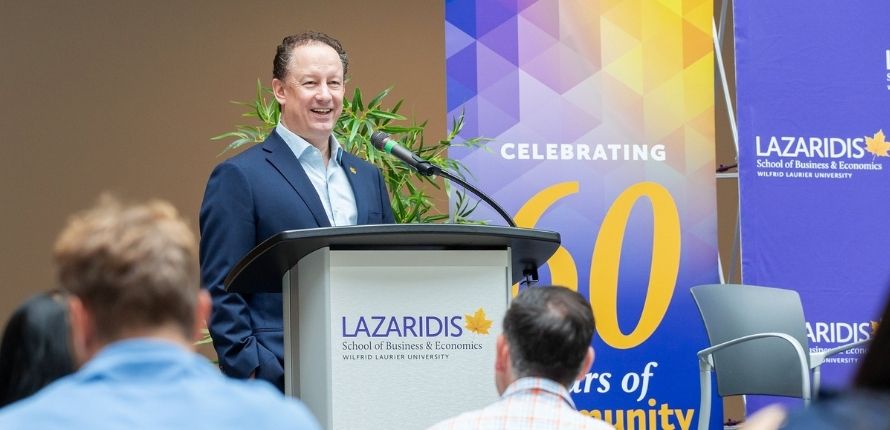
This first panel asked: how does business school research create real world impact?
The panellists included Lazaridis faculty Professor Jonathan Farrar (Accounting), Dean Kyle Murray, Professor Tammy Schirle (Economics), and Associate Professor David Wheatley (Operations and Decision Sciences).
The panel began with a presentation from moderator, Tarah Hodgkinson, associate professor of criminology, and the newly appointed director of research impact at Laurier.
She began with an overview of traditional academic metrics of research impact and the shift across universities, including Laurier.
"Research impact is what happens after the research is completed. It is the outcome of the research" said Hodgkinson. "Within Canada and across the world...there's a shift in how we're talking about and evaluating research. Increasingly, there's a recognition that research success should be evaluated on societal impact. That doesn't mean it's the only way, but it is an additional way."
Hodgkinson explained traditionally, the impact of research was measured in bibliometrics or more academic measures of success (like number of papers published and how often these papers are cited in other works) but noted, "A lot of [researchers at Laurier] do work with our communities, colleagues, and community partners" meaning there are many other ways to measure research impact.
Panellists noted how their research contributed to different areas of impact. Depending on the department or area, research has different audiences and different outcomes.
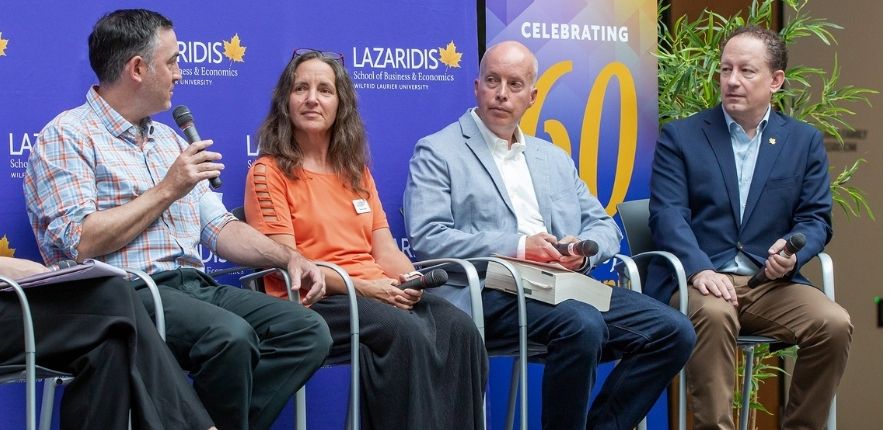
For economic policy researcher, Tammy Schirle, and behavioural tax researcher, Jonathan Farrar, their work as researchers had a clear audience of government stakeholders who influence policy, laws and legislation. Both Schirle and Farrar mentioned a focus on building relationships with those in government to ensure their research reached the right people who can then create the impact.
"Some comments I made on social media turned into a working document in the Department of Finance, which ultimately became our expansion of the Canada Pension Plan, or at least part of that conversation. I'm not going to say I wrote the legislation, but I talked with the people who are."
In Farrar's case, he took a job at the CRA to work directly with the people who create and enforce tax policy.
"If people know you exist and they want to hear what you're working on, that to me would be research impact," said Farrar. "Even if nothing comes of it right away, as long as they know you exist and they're aware of what you're doing."
For Operations and Decision Sciences (ODS) and Supply Chain researcher, David Wheatley, projects begin with impact top of mind. He has recently been working on research in Northwest Territories and Nunavut, working directly with First Nations communities to address northern food security and food sovereignty issues.
"Advocacy has become the point. Like how can we get governments to influence the market players so that they, or to steer funding in the right direction so that the communities and the transportation companies and the retailers all coordinate to make food cheaper," says Wheatley. " I feel free that I don't need to put out the publications and instead...[try] to put out community reports, meet with government officials, meet with the companies, and actually get them to change."
Dean Murray, discussed a more traditional approach to his research. As a behavioural scientist studying habit format and decision-making, research impact can be less obvious or clear right away.
"I'm going to be the one kind of traditionalist who does not aim for impact when I start research projects. Mostly I'm driven by curiosity."
However, Murray notes some of his earlier research became foundational for more applied and impact-driven research later on. One example is a 2003 paper he wrote on artificial intelligence agents long before the days of Large Language Models (LLMs).
"Early on, we did have some machine learning, and so we thought businesses, in particular retail businesses, might start to use those. So we looked at some of the behavioral effects. That was a fairly fundamental paper, not really an applied paper. Very hard for a retailer or anyone to take that and make use of it right away."
However, because the paper was well-cited in academia, it kept Murray in the field of study, led to more publications, led to industry connections, and eventually he wrote a book intended for practitioners which had more direct application.
"All of that came from a fundamental behavioral question, not so much, 'how am I going to change the world?'"
The panel closed with recommendations for researchers to start making more impact.
Whether that's offering free consulting for start-ups, getting a part-time job at the CRA, making an impact in society involves moving beyond office walls to create deeper community connections. Through these connections, researchers become more in tune with the real-world problems their expertise can help solve.
Murray, "putting on his dean hat" reminded early career researchers should still focus on academic impact "because that's what gets you tenured and promoted and makes you popular in the academy, and it increases your value."
Other panellists agreed. A strong scholarly background also helps make your case to the policy and community stakeholders who will eventually work with you to make impacts beyond academia.
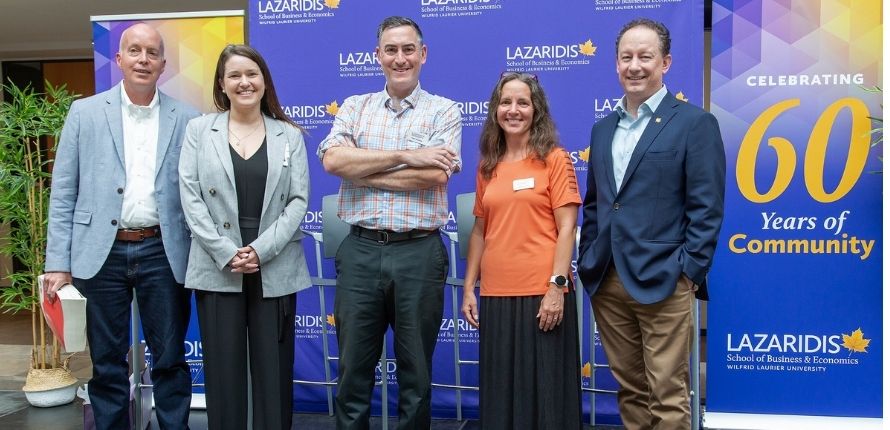
As Hodgkinson said to start the panel, impact varies across the university. And with varying needs and audiences, conversations like this allow Laurier to provide more and ongoing support for researchers across the institution.
"A lot of folks are already making research impact... I think it's about how we support that at the faculty level, at the school level, and of course at the university level. How do we create resources that support that and push that forward? And how do we recognize some of the challenges that are coming forward for folks, particularly around the amount of time it takes to do really impactful research?"
The second panel featured members of the Lazaridis AI Development task force sharing insights and thoughts on the use of Artificial Intelligence in academic research.
Panellists included Professor Hamid Noori (ODS), Associate Professor Rima Khatib (BTM), and Associate Professor Martin Qiu (Marketing). The discussion was moderated by Assistant Professor Brandon Mattalo (Strategic Management) who is also director of the Lazaridis Intellectual Property Lab.
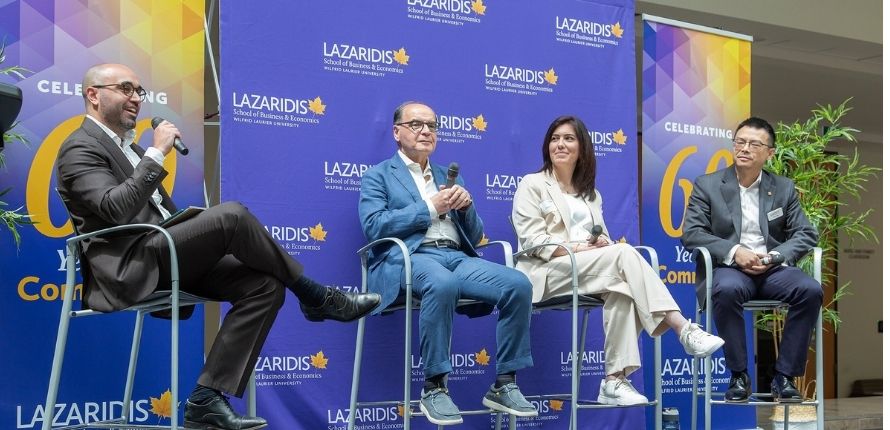
As AI changes how all work at universities is done, this was the first open conversation at Lazaridis School focusing on AI and research. The panel shared their insights on how they use AI tools for conducting research, how AI is reshaping publishing and where to exercise caution in both realms.
The panel started with a question from Mattalo asking these AI-savvy researchers what they do and do not use AI for in their research.
"I personally do not put a lot of trust in AI to help me with critical thinking," said Noori. "AI can help us do the legwork that otherwise would take a lot of time before we get to the real challenge of doing the research. I would definitely use it to understand whether or not the question that I want to investigate is viable or if I'm on the right track... But I would not let the AI decide for me what should be the methodology that I have to use."
"AI is very useful for summarizing, synthesizing, and extracting, but it is not the tool to use to make a decision on our behalf," said Khatib. "It can brainstorm for us, it can ideate for us, but it is not the one that we should use for like the final answer."
For Qiu, categorizing types of tasks during research is helpful in assigning AI to the tasks it performs best, "I divide research talks into three categories: routines, creative, and tech-related... For routine tasks, AI can just write script to deal with those tasks, which can yield a really reliable outcome. So I would trust AI with that... For creative [tasks], humans should take full control, and impose human verification all the time. For technical-related tasks, I believe AI was originally invented by developers who try to use AI to solve tech-related tasks. AI is good at tech-related tasks as well, so I use that a lot."
Qiu notes the importance of continuous "human audits" for all tasks. For more complicated data anaylsis, he described how he uses many different agents and develops AI project management teams (or agentic workflows) to conduct different routine analysis tasks of researchers. But noted these agents would often check-in with him, the human agent, at key stages.
Noori also shared an example from his area of operations research, where agentic workflows can be used to simulate how different stakeholders in a supply chain (customers, retailers, suppliers, etc.) may react in simulated disruptions or crises like wars or disasters. Mattalo noted creating similar simulations, but with roles in classrooms for his research.
All panellists agreed the more creative work of research, like writing, developing ideas, and deciding methodologies are better left in the hands of humans.
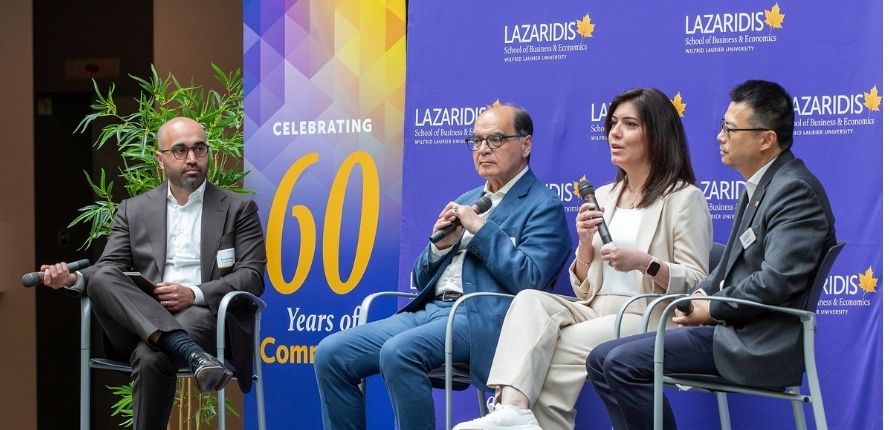
The panel also discussed how AI will re-shape processes across research, not only conducting the research itself, but also for the journal review process. As more researchers use AI, there will be more submissions to already competitive journals. And as journals themselves use AI to review, there is an ever-crucial human element needed to validate all submissions and results.
Noori, who is also a journal reviewer and sits on journal review boards noted, "at the end of the day, we are not going to benefit from this massive amount of analysis that AI could do for us if we do not really look at the findings in a proper way. "
Researchers also face challenges like online surveys being less reliable because participants are using AI agents to fill them out. And there were more stories of papers being redacted from journals after discovering the AI analysis within them was inaccurate (but not before hundreds of other papers cited the data from the inaccurate one).
Matallo shared his experience receiving feedback unrelated to with the paper submitted, in a very "ChatGPT-style voice." Indicating journal reviewers may be using AI in their reviews and administration.
In conclusion, the panel seemed to agree there are many potential benefits to AI use in research (better workflows, deeper analysis, new kinds of analysis) that can outweigh some of the concerns of inaccuracy. This is especially true when human judgement remains the foundation of research projects. Like Noori mentioned, "it's not whether we use AI, but how we use it."
Those looking to use AI as a shortcut or time-savers may find AI doesn't provide these benefits. As both Mattalo and Qiu noted, it may not make research outputs easier or faster. However, AI will allow for more information and analysis to be completed more efficiently, which has potential to increase quality of data and decision-making in research.
As Khatib stated, "While I encourage our students to use AI as much as possible, I always want them to know and realize that, at the end of the day, human judgment is the most important part of the process."
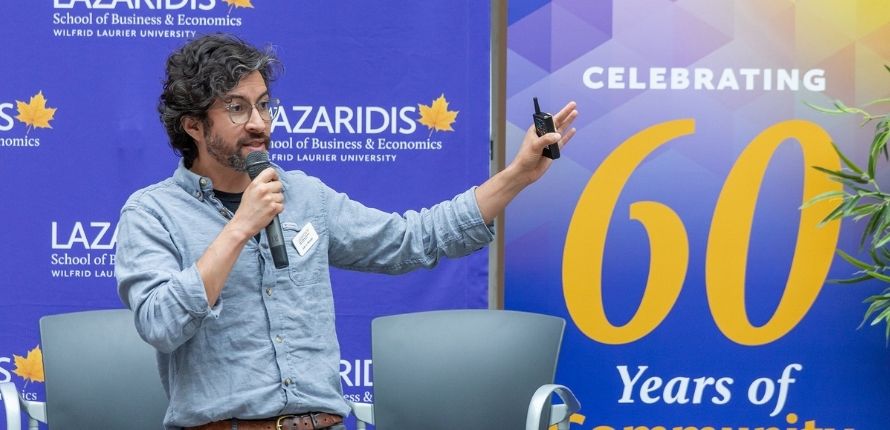
Following the first panel, four faculty members and one PhD student took the opportunity to highlight their research in rapid, 10-minute presentations.
Jie (Kassie) Li (Assistant Professor, Organizational Behaviour and Human Resource Management) presented "The More Ideal Candidates, the Less Creative Choice."
Eric Wilson (Assistant Professor, Finance) presented "Hidden Conditioning Information: The Case for Hedge Funds as Test Assets."
Nicholle Kovach (CPA, PhD Student, Accounting) presented "Knowledge Sharing in Organizations."
Nudrat Mahmood (Assistant Professor, Strategic Management) presented "Digital Platform Governance."
Juan Morales (Associate Professor, Economics) presented "Podcasts, Attention and Public Health: Evidence from the Joe Rogan Experience."
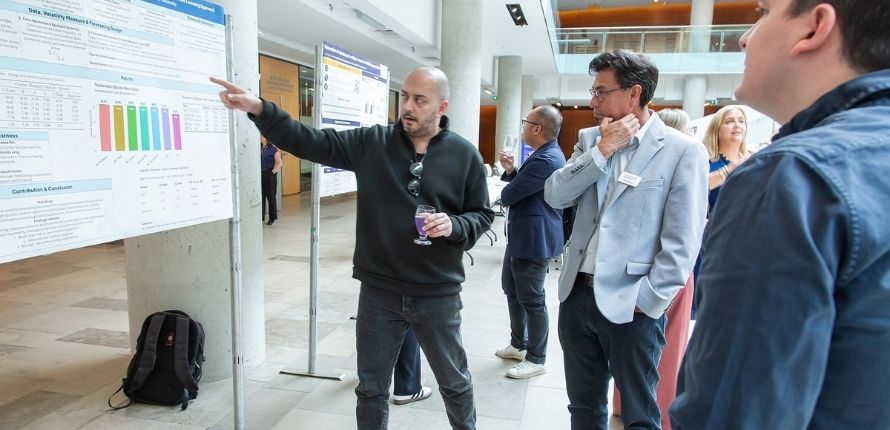
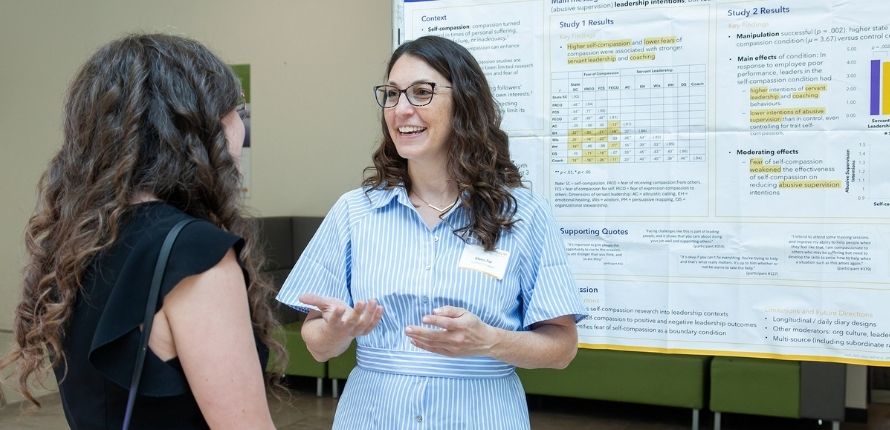
The day concluded with a final reception, where all Research Day participants had a chance to see a collection of PhD student research posters, allowing more senior faculty to offer questions, thoughts and insights to student researchers. The following topics were presented:
Yijia (Vita) Cao (Marketing) presented "Generative AI streamers in action: A source credibility perspective."
Negin Karimani (Operations and Decision Sciences) presented "NFT Market Competition Under Bandwagon Effect and Decentralized Secondary Market."
Hien Nguyen (Finance) presented "Environmental Water Violations and Firm Cost of Capital."
Fatemah Vafaeesefat (Marketing) presented "Definitively Original: The Effect of the Definite Article in Brand Names on Perceived Originality and Consumer Responses."
Zhuwei Zhang (Operations and Decision Sciences) presented "Identifying Hidden Critical Suppliers in Multi-Tier Supply Networks: A Dual-Metric Framework Using CI and NSI"
Elana Zur (Organizational Behaviour and Human Resources Management) presented "Self-Compassion and Leadership: The Moderating Role of Fear of Compassion"
*Some panellist quotes have been altered for brevity and clarity