




We use cookies on this site to enhance your experience.
By selecting “Accept” and continuing to use this website, you consent to the use of cookies.

April 21, 2026
Print | PDFFood insecurity remains a critical challenge in Canada’s North, with the Northwest Territories and Nunavut reporting the highest rates in the country. Inuit and First Nations communities continue to face intersecting environmental, economic and social barriers rooted in the ongoing impacts of colonization, climate change and limited access to reliable food systems.
Wilfrid Laurier University researcher, David Wheatley, is working with a team of researchers who are leading multi-disciplinary projects to address food insecurity in northern communities. Wheatley, assistant professor in Operations and Decision Sciences at the Lazaridis School of Business and Economics, is contributing expertise in supply chain and analytics to two initiatives focused on strengthening food systems and improving long-term food security in the North.
With $7.8 million in funding from the federal government’s NSERC-SSHRC Sustainable Agriculture Research Initiative, Wheatley is part of a team of researchers working to provide more sustainable food systems and better access to fresh and healthy foods. Led by Laurier Geography professor, Andrew Spring, this Future Harvest Partnership is supported by an interdisciplinary team of leading academics from across North America, and informed by Indigenous Governments and traditional knowledge.
The Partnership engages with with the Government of the Northwest Territories, the Territorial Agrifood Association, food producers and local communities of the Northwest Territories to co-create research and generate useful insights for innovation and policy that can inform the development of a climate-resilient local food system.
Wheatley is working with postdoctoral fellow, Behnaz Gharakhani Dehsorkhi, who is developing a multi-objective food distribution optimization model to plan new supply chains for perishable food in the Northwest Territories.
Her work includes mapping the food supply network and examining how key supply chain decisions - such as transportation, routing, the use of regional hubs, and local farmer production capacities - influence operating costs, carbon emissions, and delivery times. By analyzing these trade-offs, her research helps identify more efficient and sustainable approaches to improving access to fresh, reliable food in these communities.
While the environmental and economic toll of flying food to northern communities is clear, Wheatley's supply chain insights on the project evaluate whether growing food in northern communities is a more sustainable solution than air transport.
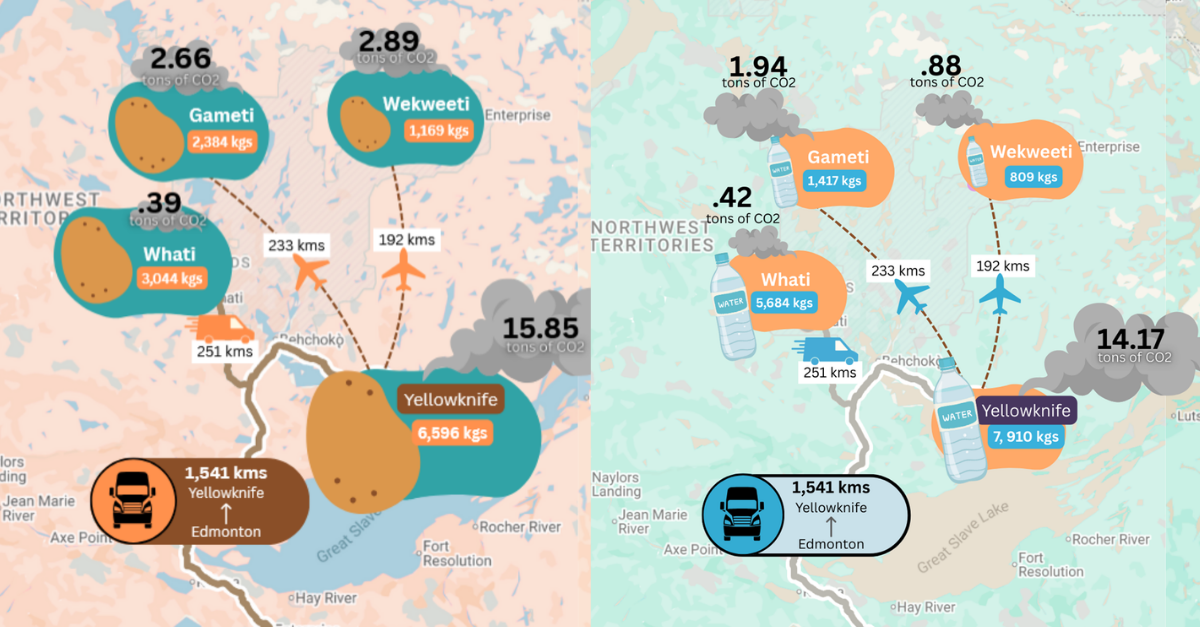
Research shows growing food on permafrost soils releases more carbon than southern soils, but transporting food up North also has a heavy carbon toll. Megan Cooper, a former Research Associate located in Yellowknife working within Wheatley’s research team, conducted an evaluation of potential carbon emissions from the current means of transportation versus growing food more locally.
The team’s initial research set a baseline for the current carbon dioxide emissions from ground and air transport comparing vans, planes, and semi-trucks. As the Future Harvest Program builds greenhouses and food-growing operations in the Northwest Territories, their data can be used as a baseline to compare the emissions associated with growing food locally.
“Working with the Future Harvest team has been an incredible opportunity to learn about Northern Indigenous communities and the unique challenges they face, while applying supply chain analytics to one of Canada’s most pressing challenges," says Wheatley.
"Our goal now is to quantify the environmental and economic trade-offs of northern food production. By estimating the carbon dioxide emissions for every product that could be grown or manufactured locally, we can provide a clear roadmap for cost savings and carbon reduction. We aren't just looking at farms and greenhouses; we are studying the entire supply chain to find strategic opportunities for warehousing and consolidation that make fresh food more reliable, accessible and affordable.”
Through his work on the Future Harvest Partnership, Wheatley was asked to join another interdisciplinary research team to help evaluate the effectiveness of an emergency nutritional support program for Nunavut families.
With researchers from University of Colorado Boulder, University of Toronto, Toronto Metropolitan University (TMU), and University of Manitoba , Wheatley and the team evaluated the effectiveness of the Inuit Child-First Initiative (ICFI)’s Hamlet Food Voucher Program – a program designed to tackle high food insecurity in Nunavut, helping families afford nutritious food and reducing reliance on costly store-bought food.
The researchers partnered with the ICFI and Indigenous community organization, Qupanuaq, in addition to Indigenous community leaders, social workers, anthropologists, economists, and supply chain experts. They published their preliminary findings in a report outlining the critical need for additional support.
The report outlined that 79 per cent of Inuit children in Nunavut experienced food insecurity and lacked access to nutritious foods as of 2022, despite the benefits of the Hamlet Food Voucher Program. Furthermore, over 41 per cent of families in the communities studied live below the poverty line.
With continuously rising food prices in the North, the Hamlet Food Voucher program was introduced to provide financial relief to Nunavut families with children. However, members of these communities were concerned whether corporations were passing along the relief from subsidies, and worried the voucher program may increase food costs even more.
The ICFI partnered with TMU Economist, Nicholas Li, and Wheatley to research inflation to Nunavut’s food prices before and after the introduction of vouchers. Some communities received vouchers, and some did not, creating a natural experiment where Li and Wheatley were able to accurately compare rising food prices in communities with vouchers and those without.
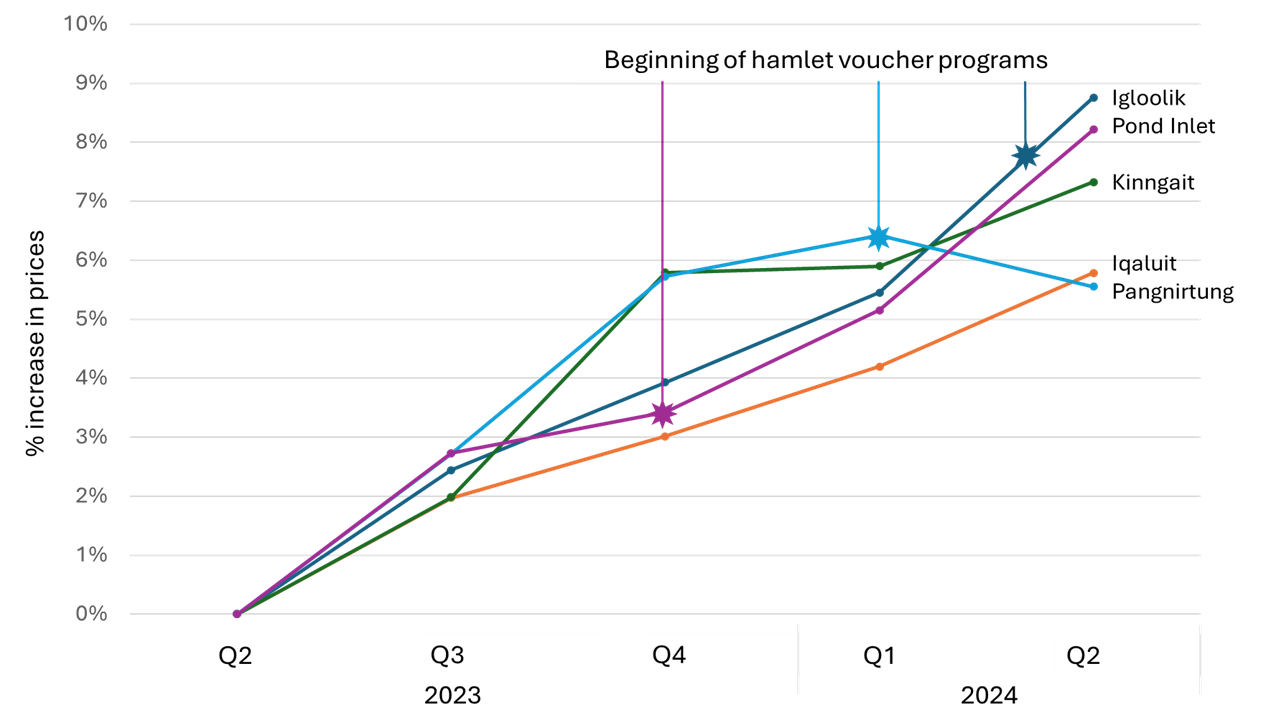
Ultimately, the team’s findings showed prices rose at about the same rate in communities with vouchers and those without vouchers. Li’s and Wheatley’s evidence showed the Hamlet Food Voucher program was effectively not contributing to rising food prices in Nunavut.
Other members of the research team also collected qualitative data through interviews with local community members, showing the program was having positive social and health benefits.
Despite this research, the food voucher program was discontinued in March 2025, leaving these Northern communities with continuously rising prices and no financial relief. Over one year later, there is no program that replaces the community-wide vouchers or offers families ongoing relief.
“This initial research showed hopeful impacts: government support led to positive short-term social and health impacts on communities, with minimal impacts on inflation,” says Wheatley.
“Our team is now investigating if access to more healthy food during the voucher also contributed to positive health and social impacts. More advocacy is needed to raise awareness of these social challenges and were hopeful more research and data will support these Indigenous-led initiatives in making the case for more financial and social support from territorial and national governments."