


We use cookies on this site to enhance your experience.
By selecting “Accept” and continuing to use this website, you consent to the use of cookies.
June 4, 2026
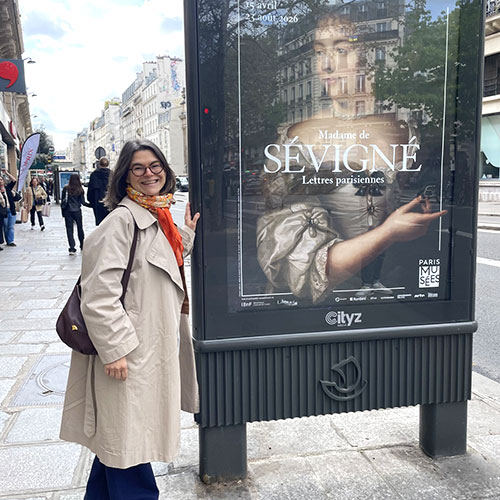
Print | PDFSince her days as a university student, Nathalie Freidel has been fascinated by Madame de Sévigné, a 17th-century French writer known for her three-volume anthology of letters. Through Freidel’s research – including two books and a digital database of women’s letters – she has sought to redefine the perception of Sévigné from a mother figure to “a woman who built a literary career when it was not a given.”
Now Freidel, a professor of Languages and Literatures at Wilfrid Laurier University, is bringing Sévigné’s work off the page and into a museum for a special exhibit at the Musée Carnavalet in Paris. Running from April 15 to Aug. 23, the exhibit marks the 400th anniversary of Sévigné’s birth. Freidel co-curated more than 200 works, including manuscripts, paintings, sculptures, musical instruments, furniture and décor, that evoke Sévigné’s life and work. Freidel is eager to “make women from this era visible” and reach more people than traditional scholarly work.
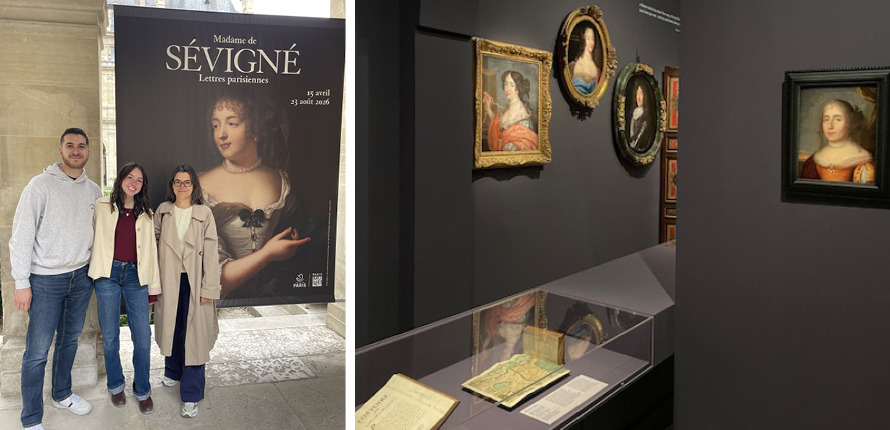 Freidel (right) and Laurier exchange students Simone and Nem, who were among the exhibit's first visitors.
To include Laurier students in her Parisian adventure, Freidel is currently leading a travel course called “Paris was a woman.” Students are enjoying a range of activities, including a private guided tour of Versailles with one of the palace’s curators and two days of conferences at the Musée Carnavalet. Follow along on the @laurierlanglit Instagram feed.
Below, Freidel reflects on Sévigné’s legacy and this career milestone.
Sévigné was born in Paris in 1626 – exactly 400 years ago – in an aristocratic family. She received an excellent education – a rare thing for women of her status during that period – and was involved in brilliant literary circles. In her time, she was known for her eloquence and social skills.
Meanwhile, like many other women of noble status, Sévigné wrote a lot to her family, her friends and acquaintances. None of these were published during her lifetime. The first editions of the letters to her daughter appeared in the 18th century and became instant classics. Readers discovered an extremely talented writer, but also an extraordinary account of Louis the 14th’s reign and a rare record of a woman’s everyday life, thoughts and affects.
For the longest time, women’s art has not been taken seriously. The happy few women writers who made it into the canon, like Sévigné, received special treatment. It was agreed that they were talented but always in relation to the social roles they were supposed to perform. Mostly, Sévigné’s letters were read as the “love letters” of a mother to her beloved daughter. Addressing the persistence of these gender biases was a priority, both in the exhibition project and in my most recent essay, Sévigné dans le cercle des femmes.
It feels amazing! I have learned a lot through the three and a half years of preparing the exhibition and it is incredibly rewarding to see visitors looking at the art, reading the panels and listening to the recorded letters. Since the opening, the museum has recorded an average 500 daily visitors. With my co-curators, Anne-Laure Sol and David Simonneau, we guided a good number of visits, including one for 60 journalists from national and international media. Major French newspapers have reviewed and promoted the exhibit. We also hosted a group of influencers, which resulted in great social media posts.
It is extraordinary to raise so much interest by showcasing the work of a woman who wrote letters more than three centuries ago.
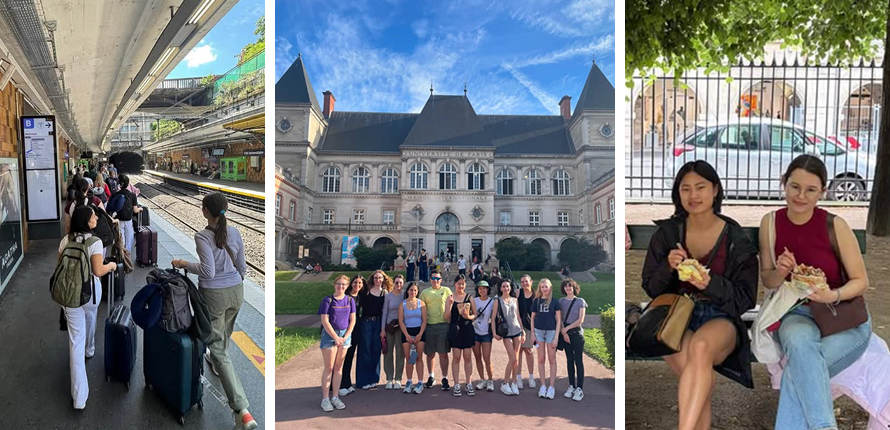
Students from Laurier's Department of Languages and Literatures are enjoying their time in Paris.
From February to May, the Carnavalet museum felt like my second home. I know most of the people working there, from curators to admin and staff. The surrounding neighborhood, the Marais – one of the oldest and most animated areas in Paris – is one of my favourites. I have also visited many exhibitions and sites in preparation for the upcoming travel course.
One could not dream of a more exciting and immersive experience for language students. I am looking forward to roaming the Louvre, Versailles and, of course, my “second home” with the FR289 students in search of the Parisian “matrimoine,” which translates to mean “women’s heritage.”