




We use cookies on this site to enhance your experience.
By selecting “Accept” and continuing to use this website, you consent to the use of cookies.

Jan. 28, 2026
Print | PDFWilfrid Laurier University historian Eric Story is embarking on a four-year research project that will shed new light on one of Canada’s most devastating — and often overlooked — public health crises: the tuberculosis epidemic of the late 19th and early 20th centuries.
Story, an adjunct professor in Laurier’s department of History and a research fellow at the Laurier Centre for the Study of Canada, was recently awarded $400,000 from the National Sanitarium Association to examine patients’ experiences during tuberculosis (TB) treatment and after their recovery. The association operated some of Canada’s earliest TB treatment facilities and is now a charity that funds research in respiratory health.
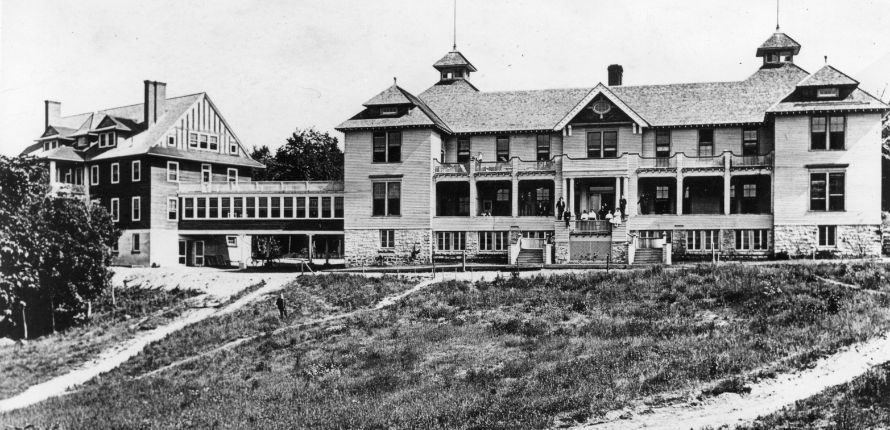
A sanatorium in Muskoka in 1904. Photo credit: Gravenhurst Archives
“TB was Canada’s greatest epidemic of the 20th century,” says Story. “We often think of the Spanish flu, but that lasted two years. TB persisted for decades — from the late 19th century until the 1950s, when antibiotics finally curbed its spread.”
The epidemic transformed public health policy and infrastructure. It also shaped lives in profound ways, leaving many patients with chronic illness and disability long after treatment ended.
Before antibiotics, the primary treatment for TB was long-term care in sanatoria — institutions often located in rural or mountainous areas where patients were prescribed rest, fresh air and nutritious food. The first sanatorium in Canada, the Muskoka Cottage Sanatorium, opened in 1897 in Gravenhurst, Ont.
“By 1914, sanatoria were considered the best chance for survival,” says Story. “But they were also complex institutions. Many histories portray patients as victims. While there was hardship, there was also agency. Veterans, for example, often had more control over their treatment because the state covered their costs.”
Story’s project will explore these nuances, examining how patients navigated treatment and life after discharge, as well as how TB connected with disability, poverty and social stigma. He says he is committed to humanizing the epidemic.
“Putting a face to TB is important, but it must be done with dignity,” says Story.
The story of Lilly Samson is one that helps tell the story of Canada’s TB epidemic. Samson was a 27-year-old teacher who died in 1927 after four years of treatment for TB at the Muskoka Cottage Sanatorium. Decades later, a shoebox full of letters to her family was discovered and published by Samson’s niece Diane Sims in a book titled A Life Consumed: Lilly Samson’s Dispatches from the TB Front.
“Lilly was a courageous, brave woman ahead of her time, taking on the mantle of caregiver for her family, although she was herself so ill,” says Sims. “I would certainly epitomize her as the face of TB.”
The letters are a treasure trove for Story’s research.
“They are just absolutely rich letters, a wonderful addition to the qualitative side of this research project,” says Story.
TB may be perceived as a disease from another era, says Story, but it remains a global health threat.
“In Canada, TB rates are low overall, but they remain alarmingly high in northern and Indigenous communities,” says Story. “Among Inuit populations, rates are 37 times higher than the national average. Among First Nations communities overall, they’re about three times higher.”
About one-quarter of the world’s population carries the bacterium that causes TB, according to the World Health Organization. While most people never develop symptoms, TB is still the world’s leading cause of death from infectious disease.
“This research project is unique because it is being funded by an organization that usually funds medical science,” says Story. “That they see value in a historical project speaks to the relevance of tuberculosis today.”
Story hopes the project will garner attention to a disease that still affects many people.
“The legacy of tuberculosis is alive in Canada,” says Story. “Understanding its history is essential if we want a healthier, more equitable future.”