


We use cookies on this site to enhance your experience.
By selecting “Accept” and continuing to use this website, you consent to the use of cookies.
Feb. 3, 2026
Print | PDFAs a professor at Wilfrid Laurier University, Stephen Wenn’s mission is to make history interesting to his students. He uses his decades of research on the Olympic Games as an entry point to historical events, placing sport within the context of its time.
Wenn had no trouble making the 2020 Summer Olympics interesting in his latest book, A Games Changer: The International Olympic Committee, Tokyo 2020 & COVID-19. He and his longtime collaborator, Bob Barney, went behind the curtain to interview five current and former International Olympic Committee (IOC) staff members, as well as Thomas Bach, then IOC president. The authors travelled to Lausanne, Switzerland, home to the IOC headquarters, to learn about the unprecedented decision to postpone and then host the Olympics a year later in the middle of a global pandemic.
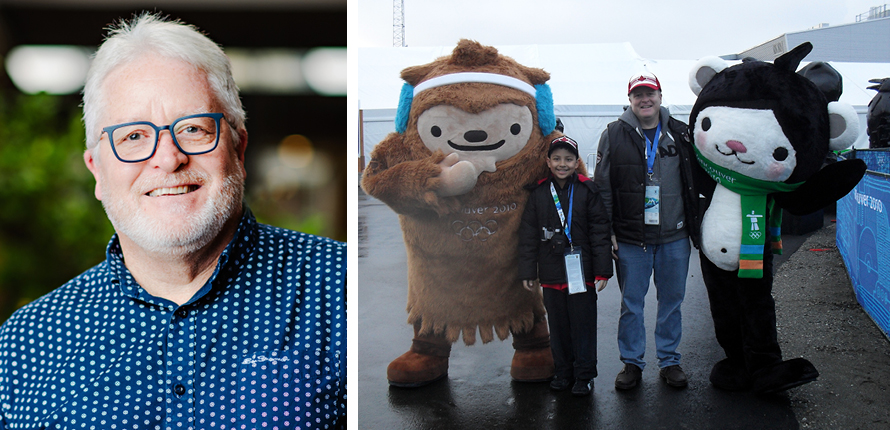 Wenn (left) has many fond memories of the Olympic Games since childhood, including a trip to the Vancouver 2010 Games (right) with his then-10-year-old son, Tim.
Below, Wenn shares five interesting takeaways from his research into the 2020 Olympics.
Organizers were determined not to cancel Tokyo 2020
“IOC senior leaders were resolute that they were not going to cancel the Games. Kit McConnell, who was the sports director, told us that 70% of Olympians who take part in a summer Olympic Games only get there once. If they had cancelled the 2020 Games, 70% of those athletes would never get their shot.”
Rescheduling created countless logistical challenges
“The decision to postpone until 2021 brought a slew of questions. For example, would employers let organizing committee members extend their secondments for another year?
Pre-pandemic, Tokyo 2020 had one of the most successful ticket sales campaigns in the history of the Games. How could they re-envision ticket sales for an international audience who may or may not be able to travel to Japan in a year’s time?
Many corporate sponsorships were set to expire on Dec. 31, 2020, so those contracts had to be completely renegotiated to extend sponsorship rights into the following year when there were already new sponsors lined up to replace them.
Sporting venues were already booked by other organizations in 2021, so organizers had to renegotiate rental agreements. There were 4,100 apartments in the Olympic Village that were set to be rented to Japanese people after the Paralympics, and now they would be delayed by a year.
The list of challenges was daunting. Thomas Bach said if they had fully comprehended what they were getting themselves into, they might have thought twice about it.”
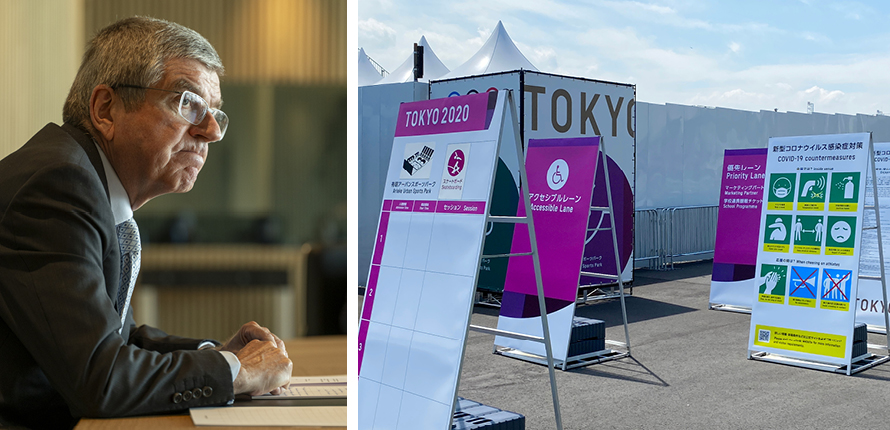 Left: Bach, moments after the phone conversation with Japanese Prime Minister Shinzo Abe on March 24, 2020 when they agreed to postpone the Tokyo Olympics. (Credit: 2020/International Olympic Committee/MARTIN, Greg)
Right: The IOC used extensive measures to keep athletes, coaches and volunteers safe from COVID-19.
Athletes had to get creative to continue their training
“Bob Barney and I interviewed Damian Warner, a gold medal decathlete from London, Ont., my hometown. Damian’s story is reflective of the determination, persistence and resilience Olympic athletes had to demonstrate to navigate the pandemic and maintain as close to normal training as possible.
Damian’s training arena shuttered during the pandemic, so he had no access during the winter months of 2020 and 2021. Out of desperation, Damian, his coaches and members of the London track and field community went through a six-week process to convert a dilapidated minor hockey arena in London into a decathlon training facility.
Athletes like Damian trained in an upside down, often compromised environment without the normal competitive events leading up to the Olympics. And then in Tokyo, they were living under restrictions, competing without spectators – everything was so different.”
Epidemiologists used computer modeling and more than one million COVID-19 tests to avoid a super-spreader event
“The IOC and Japanese organizers understood the gravity of the moment: they had to deliver as COVID-free of an environment as they possibly could. They contracted some of the best epidemiologists to use computer modeling simulations of known patterns of interaction between athletes, coaches and spectators at past Olympic Games. The simulations mapped out how to control interactions in Tokyo to mitigate the spread of COVID-19.
All participants had to be tested before they left their home countries and then couldn’t leave the Tokyo International Airport until they returned another negative result upon arrival. Athletes were sent to satellite training facilities across the country and continued to be tested every day.
Throughout the Olympics and Paralympics, about 60 medical doctors and testers operated virtually around the clock at the medical centre in Tokyo. From the entry of Olympic athletes to the departure of Paralympic athletes, they conducted over one million COVID-19 tests.
In the end, only 33 athletes tested positive out of 464 cases. The positivity rate was .02%. There was no Olympic variant or super-spreader event in Tokyo. I don’t think the general population knew the comprehensive work going on to safeguard the Games.”
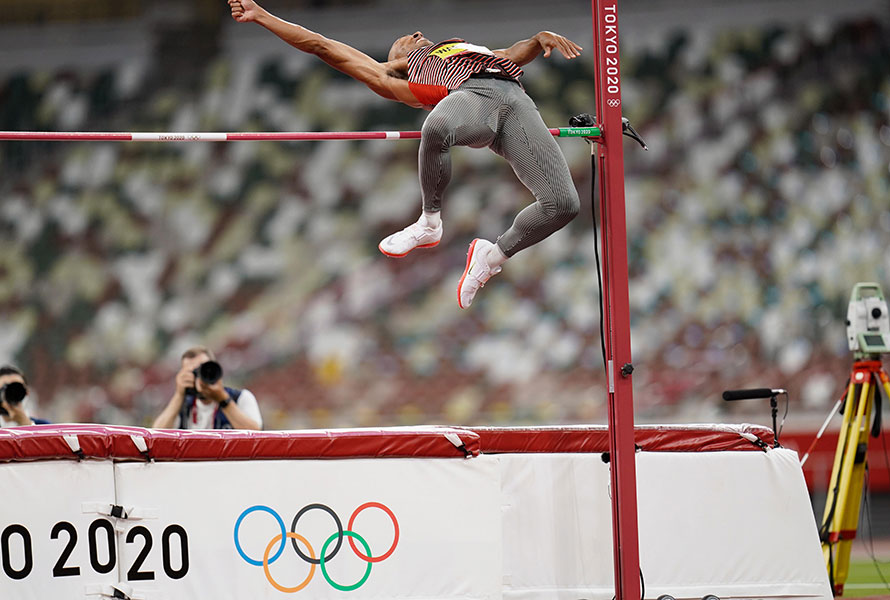
Warner competing in the decathlon at the Tokyo 2020 Olympic Games. (Credit: 2021/International Olympic Committee/EVANS, Jason)
Despite compromised training, athlete performance in Tokyo 2020 surpassed Rio 2016
“If you look at the number of Olympic and world records set in Tokyo, it basically matches what athletes achieved in London in 2012 and exceeds the results from Rio 2016. Damian Warner wound up placing first in the decathlon and set an Olympic record, becoming only the fourth man to score more than 9,000 points. At the end of the day, you have to conclude that the athletes prevailed.”