



We use cookies on this site to enhance your experience.
By selecting “Accept” and continuing to use this website, you consent to the use of cookies.
April 23, 2026
Print | PDFUndergraduate students in three Wilfrid Laurier University Sociology courses are engaging with community partners and experiencing sociology in practice through on-site experiences and in-class guest speakers.
Sociology instructor Kimberly Ellis-Hale worked with the Community and Workplace Partnerships team to embed experiential components into the courses Sociology of Health and Illness, Sociology of Aging, and Sociology of Medicine.
“These experiences support the development of transferable skills, sector-specific knowledge and professional competencies,” says Ellis-Hale. "They also foster meaningful mentoring and networking opportunities that connect academic learning with real-world contexts.”
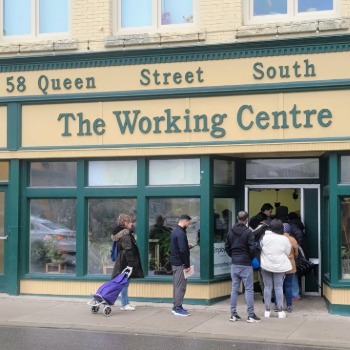
One such experience was a trip that students in Ellis-Hale’s Sociology of Health and Illness class took to The Working Centre, a community hub in downtown Kitchener. Established in 1982 by Joe and Stephanie Mancini in response to unemployment and poverty in the city, the non-profit organization provides employment support, supportive housing, food and outreach services to about 1,000 people each day across several locations.
After a brief tour of The Working Centre, students met with co-founder Joe Mancini, who spoke about the centre’s history and fielded questions about daily operations and challenges the organization is facing.
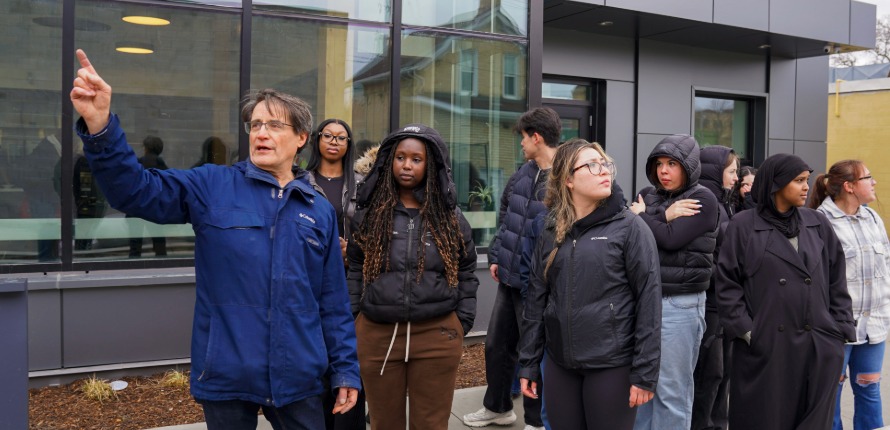
Mancini and students in the courtyard of The Working Centre's 97 Victoria St. N. campus, known as Making Home. The newly renovated heritage building houses St. John's Kitchen and other services.
Mancini then led the group of students to St. John’s Kitchen. In operation since 1985, St. John’s Kitchen is a drop-in community space that provides shelter and meals, along with public washrooms, showers, laundry, outreach supports, and medical and dental care.
For some students, this was their first time learning about The Working Centre, St. John’s Kitchen, and the clients they serve, many of whom are experiencing homelessness and medical, mental health or substance use concerns.
“Students are often impacted by the radical hospitality and relational approach they see in our spaces," says Mancini, who is a familiar presence in The Working Centre and St. John’s Kitchen and often stopped to greet and shake hands with clients throughout the tour.
Second-year Sociology student and life-long Kitchener resident Lauren Wolf-Laderoute was familiar with The Working Centre because of her grandmother, who is a community organizer and fundraiser for women impacted by domestic violence. Wolf-Laderoute credits her grandmother, among others in her life, for influencing her interest in community work. She hopes to become a psychotherapist or work in the mental health field in a role where she can support individuals in her community.
“I was attracted to the experiential component of this course,” says Wolf-Laderoute. “I don’t think I’d be able to have this experience in too many other courses.”
Other experiences Ellis-Hale's students participated in were a half-day tour of a Waterloo Region health network site as well as in-classroom discussions with guest lecturers like Dr. AnneMarie Pegg, an emergency room physician who has worked with Doctors Without Borders and Brian Paul, executive director of Supportive Housing of Waterloo (SHOW).
Following their experiences, students translated insights gained into meaningful coursework, including authoring editorial opinion pieces they were encouraged to submit to local newspapers and public presentations that drew guests from Laurier and the greater community. Experiential learning opportunities also count toward students’ Laurier Experience Record.

Situated across the street from the 100 Victoria St. N. encampment, Making Home acts as a base for outreach teams working with encampment residents.
“Opportunities like these provide students with short-term workplace and community exposure, allowing them to engage with partners and ask questions,” says Lisa Jarvis, associate director of Community and Workplace Partnerships. “Students see how roles intersect with broader issues such as health, healthcare systems, policy, and the social determinants of health.”
To learn more about Laurier’s hands-on experiential learning opportunities, connect with Community and Workplace Partnerships.