

We use cookies on this site to enhance your experience.
By selecting “Accept” and continuing to use this website, you consent to the use of cookies.

Dec. 1, 2025
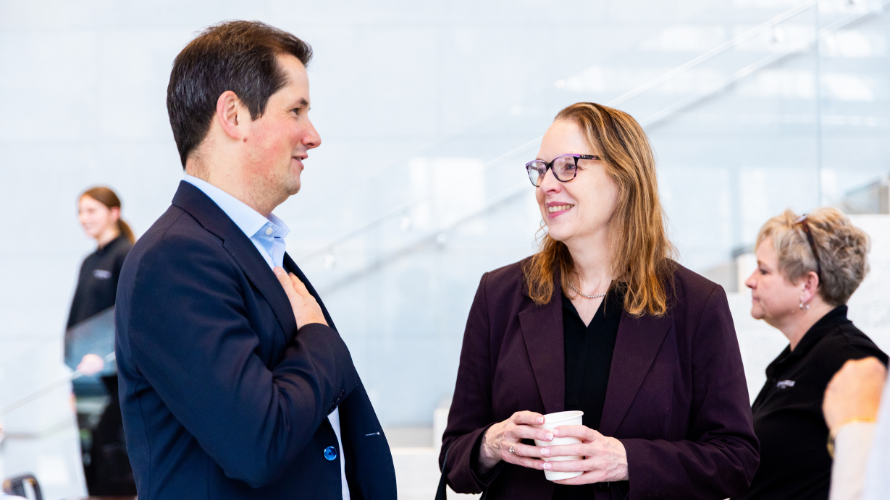
Print | PDFMore than 200 educators, students, alumni, policymakers, industry leaders, and community partners gathered at the Balsillie School of International Affairs on Nov. 21 for a day-long discussion about the future of Canadian universities in an age of rapid social, political, and technological change.
Hosted by Wilfrid Laurier University’s Faculty of Arts to cap off its 100th anniversary year, the symposium brought experts and thought leaders together to explore how best to prepare humanities and social sciences students for an evolving workforce and world.
“Students are our future leaders, changemakers and problem-solvers,” said Sofie Lachapelle, dean of Laurier’s Faculty of Arts. “To prepare them to thrive, we need a deeper understanding of the world they are entering.”
Keynote speaker David Coletto, founder and CEO of Abacus Data, shared public opinion data to set the stage for the day. His data shows a high degree of uncertainty in the Canadian public, driven by numerous crises over the past five years including the COVID-19 pandemic, global conflicts, wildfires and extreme weather events, a steeply rising cost of living, and the Trump presidency. The advent of artificial intelligence is furthering uncertainty and mistrust. Only 17% of Canadians believe they will benefit from unleashing AI, and six in 10 believe AI will eliminate more jobs than it creates.
In this environment, Coletto argued an arts education is especially relevant because it trains students to interpret a chaotic world, develop adaptable and transferable thinking, and build resilience. “Arts degrees future-proof people by giving them the capabilities AI can’t replicate, and society desperately needs,” said Coletto.
Laurier President and Vice-Chancellor Deborah MacLatchy, York University President and Vice-Chancellor Rhonda Lenton, and University of Windsor President Emeritus Robert Gordon took the stage next for a panel discussion about the challenges and opportunities facing higher education today. All agreed that we live in a moment of accelerated change where universities are adapting daily.
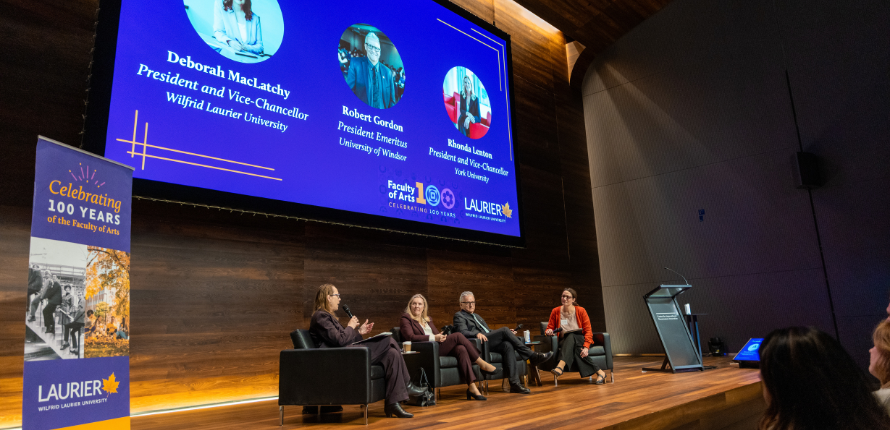
MacLatchy described the university as a three-legged stool where teaching and learning, research, and community engagement are all essential to the value and purpose of the institution. During a discussion about the role of campuses in an age of online learning, MacLatchy cited Laurier’s place as an anchor institution in Waterloo, Brantford, and Milton.
“There is widespread agreement in those communities about the transformative impact of university campuses,” said MacLatchy. “Outside of those communities, we need to tell our stories and demonstrate the value of the learning and research that happens here.”
The presidents agreed that while research in the humanities and social sciences may not make as many headlines as discoveries in science labs, it is equally vital to Canada’s future.
“An engineer designs an autonomous vehicle. A sociologist investigates what conditions make a person willing to step into a car with no driver,” said Lenton.
A second panel discussed the role of technologies in higher education and posed the question: Are universities doing a good enough job preparing students for the workforce?
Panellists included John Baker, founder and CEO of D2L; Tricia Williams, director of research evaluation and knowledge mobilization at the Future Skills Centre; and Ann Fitz-Gerald, director of the Balsillie School of International Affairs, which launched a digital governance initiative with Laurier in June 2025.
Fitz-Gerald noted that in the shift from a resource-based to a knowledge-based economy, Canada’s university-educated workforce is one of its best advantages.
“Intangible assets make up 90% of the market value of the S&P 500,” Fitz-Gerald said. “As Canada seeks to compete and prosper in the global economy, we need a highly educated workforce that can thrive in the marketplace of data, knowledge and innovation-driven ideas.”
The panel had a wide-ranging discussion about the impact of AI on education and the workplace. AI can support educators, for example by creating draft quiz questions to free up an instructor’s time to provide personalized feedback and guidance to students. But, panellists agreed, it cannot replace the vital human elements of teaching, learning, mentorship, and developing career pathways and networks.
Those networks are important to graduates as they navigate a job market in which some entry-level positions are being replaced by AI. Baker and Williams emphasized the importance of experiential learning opportunities, internships and co-op programs, such as those widely available at Laurier, to help students close skills gaps and prepare them for the workforce.
To continue the conversation, Laurier’s Faculty of Arts is forming a task force including local education, technology, workforce planning, and Laurier representatives. The task force will consider what the trends discussed at the symposium will mean for the humanities and social sciences at Laurier and across Canada and will report on their findings in the coming months.
For more information about the 100th anniversary of Laurier’s Faculty of Arts, visit the 100th anniversary web page.