


We use cookies on this site to enhance your experience.
By selecting “Accept” and continuing to use this website, you consent to the use of cookies.
Nov. 2, 2026
For Immediate Release
WATERLOO — Wilfrid Laurier University has named two finalists for the 2026 Edna Staebler Award for Creative Non-Fiction, a $10,000 prize that recognizes Canadian writers for a first or second work of creative non-fiction that includes a Canadian locale or significance.
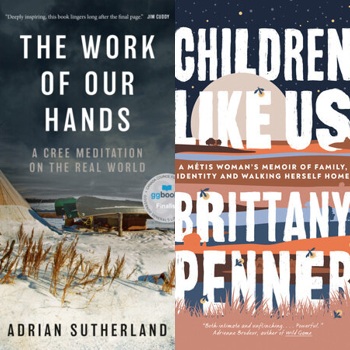
The 2025 finalists are authors Brittany Penner for Children Like Us: A Métis Woman’s Memoir of Family, Identity and Walking Herself Home, and Adrian Sutherland for The Work of our Hands: A Cree Meditation on the Real World.
“We can all agree that good writing moves us, but this year’s shortlist moves its reader with heart and wisdom in a way that is refreshingly hopeful,” said juror Mariam Pirbhai, professor, English and Film Studies. “Both Penner and Sutherland confront institutional failings of settler colonialism, from the Sixties Scoop to the water crisis of Attawapiskat, respectively, laying bare historical, material and social realities but with a deeply self-reflexive gaze, with compassion and agency, and in beautifully rendered prose.”
Other jurors are Harry Froklage, former associate director: development, in the Faculty of Arts, and Bruce Gillespie, associate professor, User Experience Design.
"I would like to offer my congratulations to both Brittany Penner and Adrian Sutherland for sharing such profound and personal accounts of their lives,” said Gavin Brockett, vice-dean of the Faculty of Arts, who chairs the Edna Staebler Endowment Committee. “Each has written a work that is worthy of our respect and gratitude for their honesty and the insight they provide into their lived experiences.”
Established and endowed by the late writer and award-winning journalist Edna Staebler in 1991, the Edna Staebler Award for Creative Non-Fiction is administered by Laurier and is the oldest national literary award bestowed by a university in Canada.
In her debut memoir, Brittany Penner begins with the question, “to whom does a child belong,” drawing the reader into what is at once a personal meditation on adoption and the search for origins, and a courageous excavation of the Sixties Scoop and its legacy, which relinquished countless Indigenous children into foster care and adoption programs rooted in assimilative colonial practice. Through the author’s skilful command of her narrative and her poignant sensibility as witness, Children Like Us invites the reader to “walk” with openness, along avenues of family, faith and identity rarely encountered in a single work of creative non-fiction — Indigenous adoption and foster care by a Mennonite family, life in a small prairie town, an enduring bond with a spirited Ukrainian-Canadian grandmother, the intimate work of reconnection and healing, and Penner’s professional journey as a physician confronted with the systemic barriers faced by Indigenous women seeking medical care. The multi-layered, intersectional and compassionately rendered fabric from which Penner weaves her story truly makes this memoir a cut above the rest.
In the popular mind, Attawapiskat First Nation is notorious as an example of Canada’s failed relationship with Indigenous peoples. Undrinkable water, unlivable houses, a suicide crisis: these are the distressing conditions that most Canadians associate with this remote, often inaccessible Cree reserve on James Bay. Adrian Sutherland escaped Attawapiskat but not its legacy of trauma. Alcoholism, family breakdown, and mental health issues afflicted him even as he fashioned a career as a successful songwriter and recording artist. But he decided to return to Attawapiskat, despite its hardships, to pursue a life that honoured the traditional practices and beliefs of his people and discover the wisdom that comes from manual proficiency. Sutherland’s book documents his mastery of five traditional tools — his guitar, a hammer, a rifle, a water canister, and a sweat lodge — and how this guides him on his path to self-reliance and self-respect. In spare prose, this slender book demonstrates how meaning manifests itself in everyday activities and provides a meditation with instructive value for Indigenous and non-Indigenous readers alike.
The winner of the 2026 Edna Staebler Award for Creative Non-Fiction will be announced in early December. An award ceremony will be held at Laurier’s Waterloo campus in the spring.
Learn more about the Edna Staebler Award for Creative Non-Fiction.
– 30 –
Media Contacts:
Emily Urquhart, Assistant Professor, Creative Writing
Wilfrid Laurier University
Lori Chalmers Morrison, Director: Integrated Communications
Wilfrid Laurier University