
We use cookies on this site to enhance your experience.
By selecting “Accept” and continuing to use this website, you consent to the use of cookies.
April 13, 2026
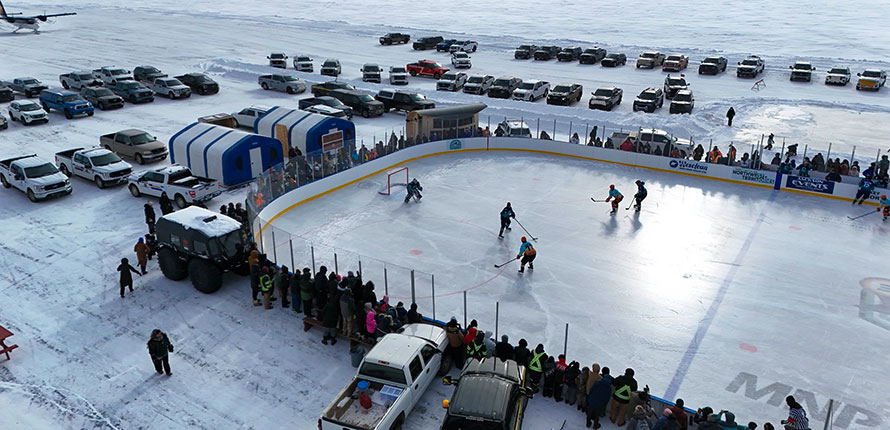
The Délı̨nę, Northwest Territories community hosted its Alumni All-Star Winter Classic on March 21 to celebrate 200 years since the local advent of hockey. As former NHL greats including Wendel Clark, Doug Gilmour and Ryan Getzlaf faced off on a specially made outdoor rink on Great Bear Lake, young spectators warmed their toes in the heated “VIP booth” on the sidelines.
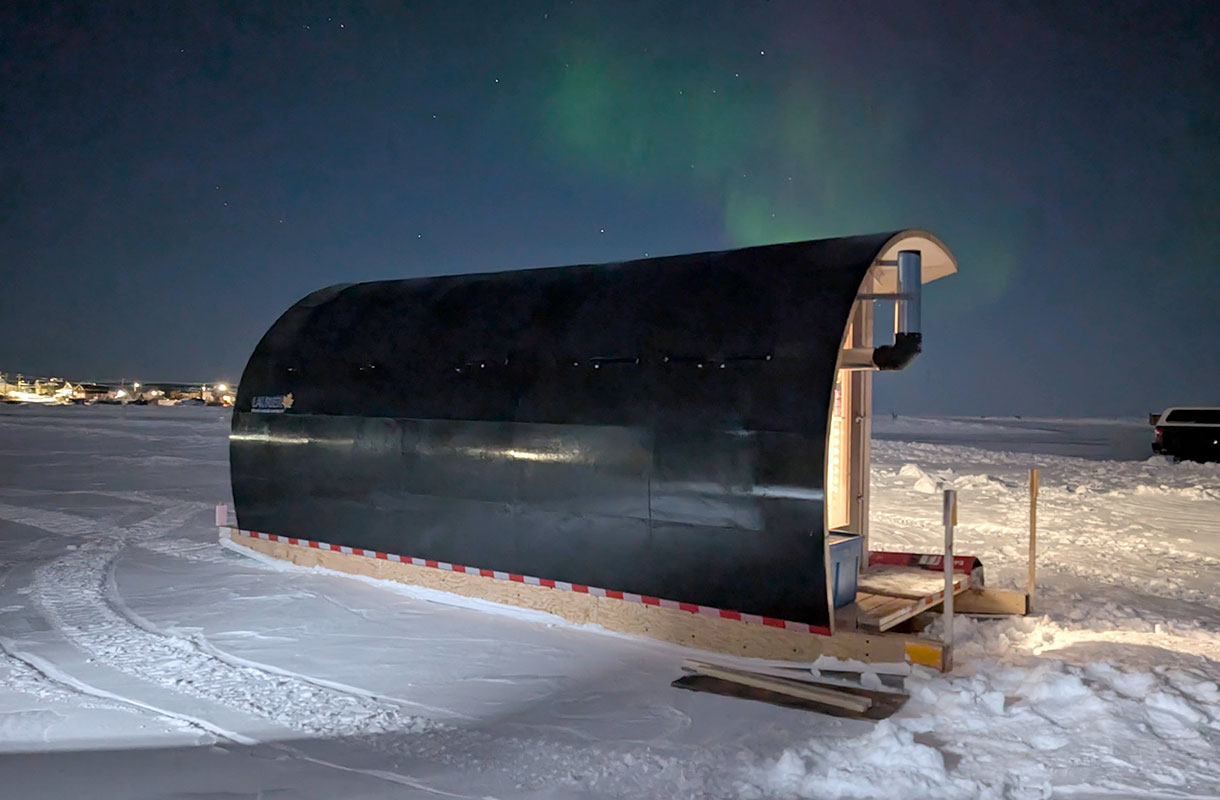
In addition to offering the best seats on the lake, the “VIP booth” – a wooden structure with a curved roof and large windows – is a portable science lab. Designed and constructed in Délı̨nę with the help of Wilfrid Laurier University Associate Professor Homa Kheyrollah Pour, the research station can be pulled across Great Bear Lake to measure water quality, ice thickness and snow properties, providing critical information for the Délı̨nę got’ı̨nę government, environmental researchers and community partners.
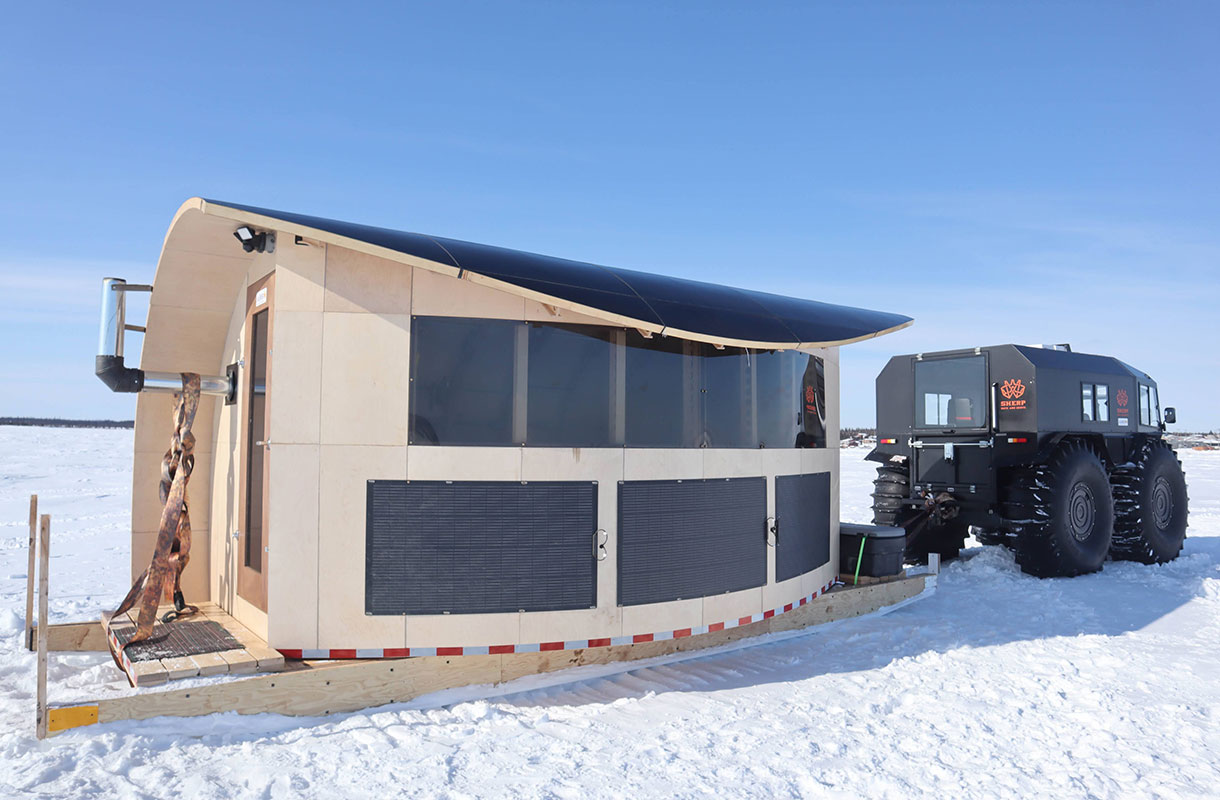
The Sahtú Lab is built on skis so it can be pulled across the ice by a SHERP – an amphibious utility task vehicle designed to tackle extreme terrains.
Great Bear Lake covers more than 31,000 km², making it Canada’s largest pristine lake. Délı̨nę is the only settlement on its shores and 500 residents rely on the water for fishing, sustenance and, in the wintertime, delivery of critical goods via ice roads.
For the past six years, Kheyrollah Pour and her students have regularly journeyed to Délı̨nę to co-create solutions for community needs, including monitoring ice thickness as climate change makes winter travel and ice road construction increasingly unpredictable. As the community grapples with bigger picture questions, including potential health issues from a closed uranium mine, the portable research station is the next step in an evolving partnership with Laurier. The Délı̨nę people want to protect Great Bear Lake for future generations, yet long-term, year-round monitoring is difficult due to its size and remoteness.
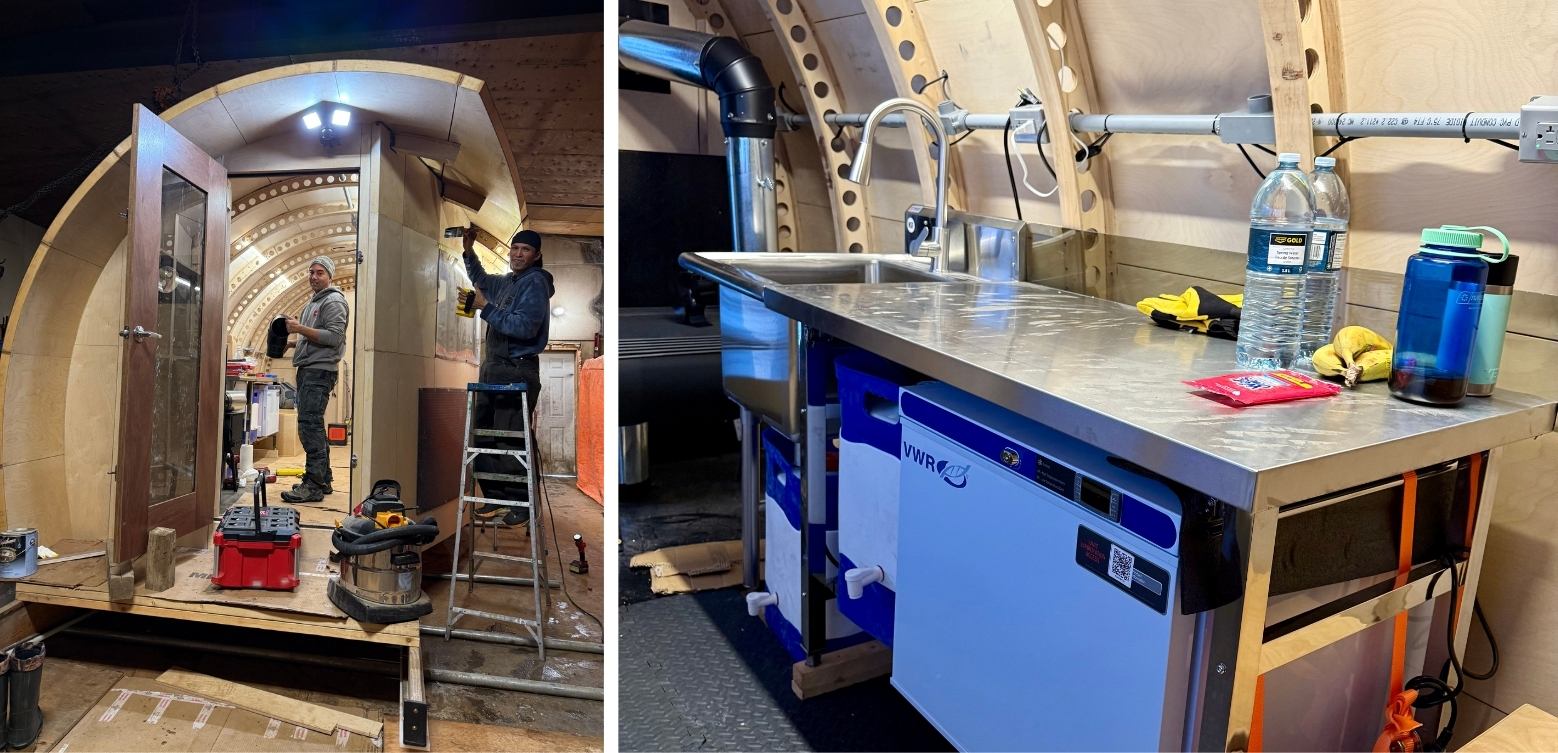
Since large-scale data collection would require costly and logistically challenging helicopter surveys, the portable research station offers a more cost-effective monitoring solution. Funded by the Canada Foundation for Innovation, the lab and its research technology are powered by a hybrid system combining solar, wind and battery storage, with backup generators to ensure continuous operation in remote areas. It is heavily insulated and designed to withstand harsh winter conditions.
The lab is built on skis so it can be pulled across the ice by a SHERP – an amphibious utility task vehicle designed to tackle extreme terrains. (The SHERP would float if it were to crash through the ice.) Because the lab can travel vast distances across Great Bear Lake, data can be collected from multiple locations, greatly expanding spatial coverage and scientific value.
“This represents a significant leap forward in how we understand, protect, and build local capacity to monitor northern freshwater ecosystems,” says Kheyrollah Pour, the Canada Research Chair in Remote Sensing of Environmental Change.
Rather than importing infrastructure from southern Canada, local community members and volunteers worked with Axis North Design to construct the research station. The Délı̨nę community calls it the Sahtú Lab, honouring their people and the Dene name for Great Bear Lake. Local expertise and traditional knowledge will guide research priorities, and Délı̨nę students will gain hands-on experience with monitoring tools through dedicated summer and winter training sessions.
“Through community leadership, youth education and real-time science, the Sahtú Lab will bring the story of Great Bear Lake to the world,” says Kheyrollah Pour.
On March 21, the people of Délı̨nę brought “the world” to Great Bear Lake – or at least some high-profile hockey players. The community built a rink just off its shoreline to host the Alumni All-Star Winter Classic, along with tents for guests to stay in. With no permanent roads into Délı̨nę, players and spectators drove in and out on the ice road or landed on Great Bear Lake on chartered planes. There was a lot of pressure on the ice – literally and figuratively.
The Winter Classic required all hands on deck, and that included Kheyrollah Pour. In the weeks leading up to the event, she mapped out the rink site to ensure the ice was thick enough.
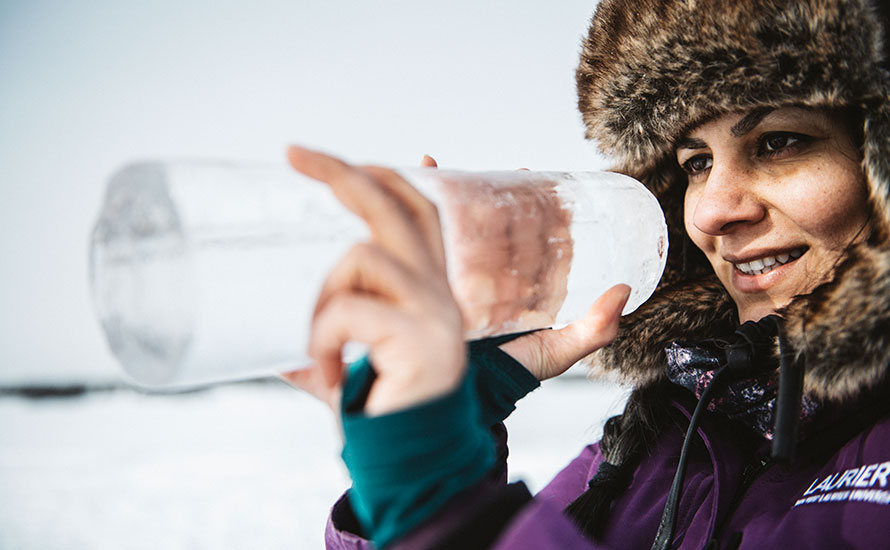
“We monitor the thickness of the ice road and report it to the community every week since the ice has to accommodate very heavy trucks bringing goods and gas into Délı̨nę,” says Kheyrollah Pour. “The difference with the hockey game was that vehicles weren’t just passing through. The ice needed to accommodate a lot of stationary weight for two straight days.”
Kheyrollah Pour’s team towed a ground-penetrating radar behind the SHERP vehicle, which takes real-time measurements as frequently as every 25 centimetres. They calculated an average ice thickness of 150 cm, which has the capacity to bear up to 90,000 kilograms – more than sufficient for the Winter Classic.
The lake ice proved to be thick enough on game day, but the constant appearance of stress cracks – common fractures resulting from temperature changes, wind and water level fluctuations – kept event organizers busy resurfacing the ice. Community members were even melting snow with blow torches to help fill cracks on the rink.
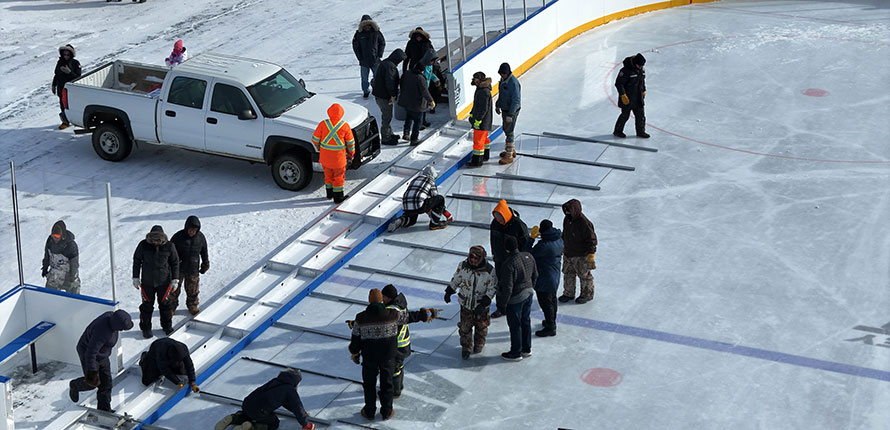
Unexpected winds picked up just before game time and blew down the boards of the hockey rink. Laurier’s Branden Walker (BA ’15, MSc ’17), a physical geography lab technician, joined community members to remove the glass and reset the boards, bracing them with two-by-fours, parked trucks and even the strength of RCMP officers.
“It was one battle after another,” says Walker. “The hockey game represented life in the North – full of challenges, but the people always make it happen.”
In the end, the ice and the boards held up and the Alumni All-Star Winter Classic was a great success. Attendees got to see Ray Bourque, Guy Carbonneau and Paul MacLean play hockey while Kheyrollah Pour provided tours in the SHERP and invited people to warm up from -30 C temperatures in the Sahtú Lab beside the rink.
“It was a blast and the community loved it,” says Walker.
Before and after the game, which was co-sponsored by Laurier, Délı̨nę hosted community meals, live musical performances by Tom Cochrane, Aaron Pritchett and Chad Brownloee, a minor hockey game, and a fishing derby. Federal and territorial officials were in attendance, including Northwest Territories Premier R.J. Simpson. Kheyrollah Pour took some of the NHL veterans for a ride in the SHERP so they could go ice fishing on Great Bear Lake.
“It was pretty funny seeing big, tough hockey players driving around and giggling like little kids,” says Walker.
After the excitement of the Winter Classic, Kheyrollah Pour got back to work the following week, introducing the Sahtú Lab to people from near and far. She took a group of Délı̨nę high school students out on the lake to learn about the portable research station and try out an underwater drone.
“Including local youth in research is important because it turns the community into a living science lab where students can learn by doing,” says Kheyrollah Pour. “It builds capacity by giving youth hands-on experience with scientific tools, methods and critical thinking. This kind of direct involvement helps them develop skills, confidence and curiosity about science, while also empowering them to contribute to research that affects their own community.”
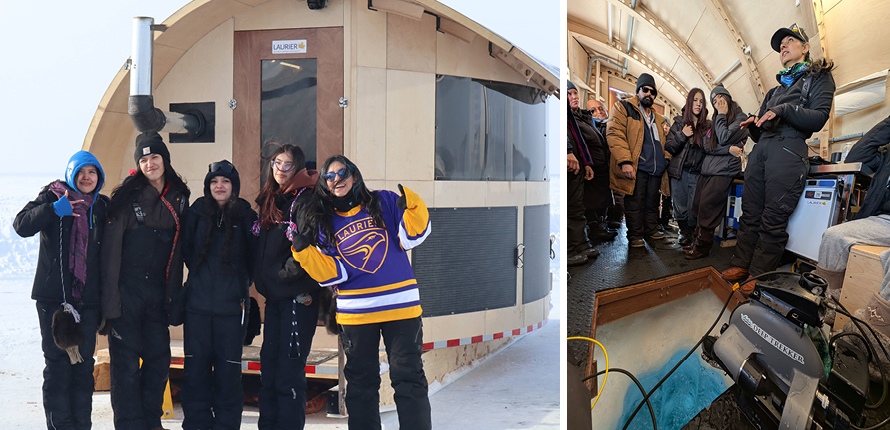
Kheyrollah Pour also attended and presented at a meeting in Délı̨nę about the importance of conducting research in the Great Bear Lake watershed, which is designated by UNESCO as an International Biosphere Reserve. Participants included community members, members of the Délı̨nę Got’ı̨nę Government, elders and UNESCO representatives.
“We showcased the Sahtú Lab as an example of community-based research,” says Kheyrollah Pour. “Our role is to support and contribute to research initiatives on Great Bear Lake, helping to strengthen its value as a scientific resource and a place of community-driven knowledge.”