




“When people get on top of their personal finances, they’re happier because they’re less stressed about money, they’re off that treadmill of constant consumption.”
David Chilton
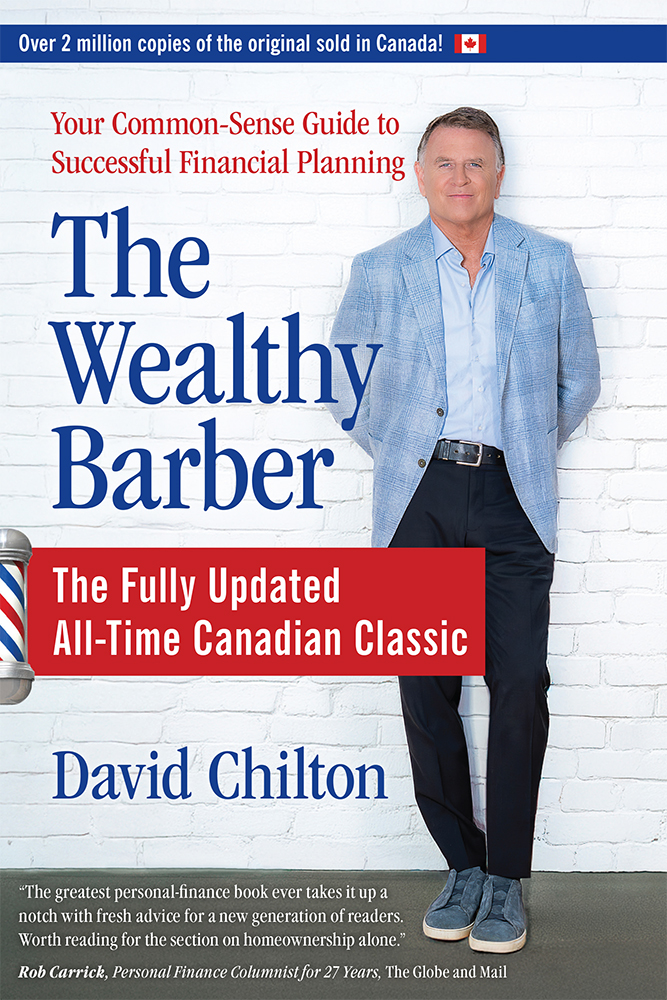
The Wealthy Barber: The Fully Updated All-Time Canadian Classic quickly reached the top of national bestseller lists upon its release in 2025.
Laurier alum David Chilton reflects on a career that transformed how Canadians think about money and why his message matters more than ever.
August 11, 2026
Nearly four decades after The Wealthy Barber first landed on bookstore shelves, David Chilton (BA ’95, DLitt ’06) is preparing to retire at the end of 2026. Before stepping away, the Wilfrid Laurier University alum, bestselling author and investor on CBC’s Dragons’ Den, returned to the book that made him one of Canada’s most trusted voices on personal finance.
In 2025, Chilton released The Wealthy Barber: The Fully Updated All-Time Canadian Classic, a complete rewrite of the original bestseller that has helped millions of Canadians better understand and manage their money.
“So much has changed since the initial book came out,” says Chilton. “I did the rewrite because I really thought I could help.”
The updated edition of The Wealthy Barber follows The Wealthy Barber Returns, Chilton’s 2011 personal finance book that moved away from the fictional storytelling format of the original to offer direct, essay-style financial advice. But with readers continuing to embrace the original’s approachable characters and timeless lessons, Chilton saw an opportunity to revisit the classic.
Questions had been pouring in from young adults navigating a financial world that hardly resembles the one Chilton wrote about during the late 1980s. Rising housing costs, growing investment account options, low-cost ETFs, higher living expenses and the constant pull of online spending all demanded a fresh approach.
What Chilton first thought would be a straightforward update of The Wealthy Barber became a significant undertaking.
“The rewrite ended up taking longer than the initial book by quite a bit,” says Chilton. “But I’m thrilled with the way it’s gone over. It seems to be helping a lot of people and that’s what it’s all about.”
The updated edition quickly reached the top of national bestseller lists, reaffirming the appeal of a book that has sold more than two million copies since it was first self-published in 1989.
While personal finance has become more complicated during the past four decades, Chilton believes a core principle remains consistent.
“You have to save,” he says. “That’s still the fundamental principle of The Wealthy Barber. So, realistically, what are the most effective ways to do it?”
Today, that means navigating RRSPs, TFSAs and FHSAs while resisting a consumer culture built around instant purchases, easy credit and endless temptation.
“It is tougher out there today,” says Chilton. “Real estate prices have gone up dramatically and spending has never been easier. All you have to do is tap your card or click a button.”
Chilton acknowledges that younger Canadians face genuine financial headwinds, particularly those trying to save for a first home. Still, he does not believe that financial success is out of reach.
“There’s a myth out there that all young Canadians are up against it, not doing well,” he says. “That is not the case. There are a lot of young people doing very well both on the income front and on the savings, personal finance front. The common denominator among people who’ve done well is they pay themselves first. They automate their savings.”

While personal finance has become more complicated during the past four decades, David Chilton says financial success is not out of reach for younger Canadians.
A significant change during the past four decades, Chilton says, is the importance of managing debt. Easy access to credit means many people can undo good savings habits by accumulating too much on the liability side of their finances.
He’s also skeptical of financial trends promising quick riches.
“There’s all kinds of advice out there online about getting involved in crypto, betting in the futures markets and the prediction markets,” says Chilton. “That’s just a way to get people to part with their money.”
Instead, Chilton advocates for disciplined, long-term investing through broadly diversified, low-cost investment funds.
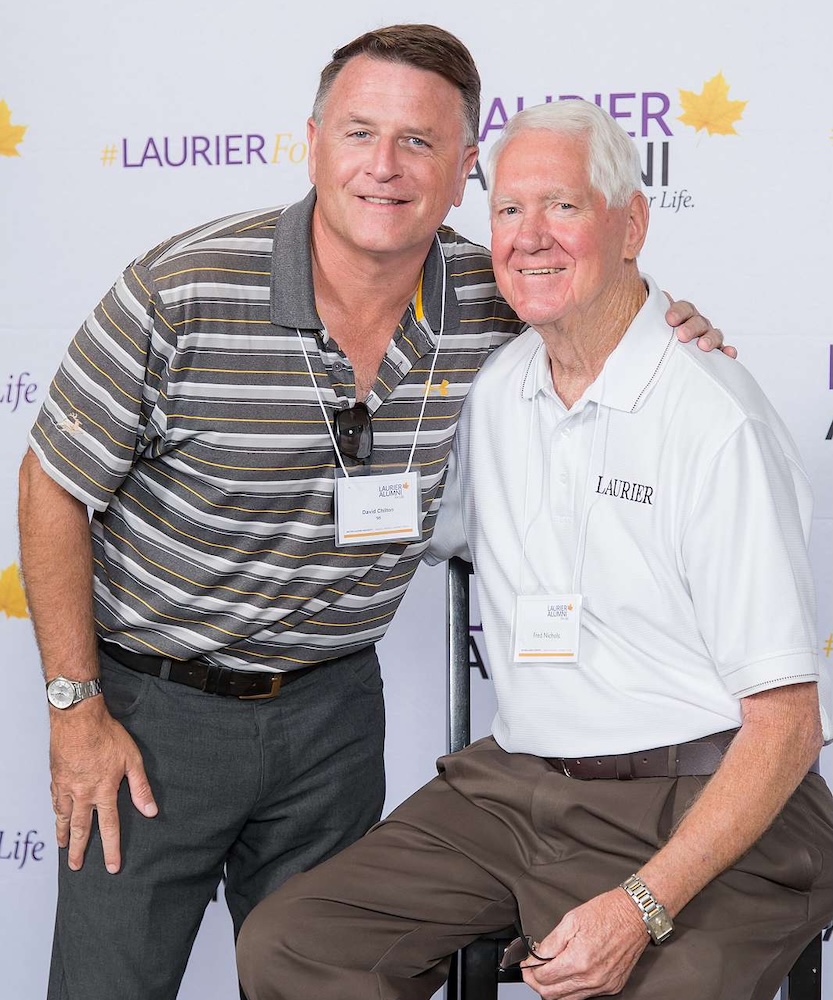
Chilton pictured with former Laurier dean of students Fred Nichols.
Long before becoming a bestselling author, television personality and one of Canada’s best-known financial educators, Chilton was a Laurier student. Helped by a scholarship earned through Reach for the Top – a television quiz game for high school students – he arrived at Laurier already interested in investing after being introduced to the subject by his grandmother.
While studying in Laurier’s School of Business and Economics (now known as the Lazaridis School of Business and Economics) Chilton and fellow Laurier student Alex Mustakis (BA Econ ’83, DLitt ’04) launched a Guaranteed Investment Certificate (GIC) agency. Today, Mustakis is well known as the founding artistic director of Drayton Entertainment.
Chilton also immersed himself in his course materials while at Laurier, crediting several professors with pushing him beyond what he thought he was capable of. He says Professor Terrence J. Levesque encouraged him to pursue his full potential, while Professor Hart Bezner also provided a defining lesson.
After Chilton earned an A in one course, Bezner surprised him by saying he was disappointed – not because of the grade, but because he believed Chilton was capable of much more. “You’re cruising to get your A,” Bezner told him. “You’re not pushing yourself.”
“I remember exactly where we were standing when he said that,” Chilton recalls. “And it always stuck with me.”
Chilton says his time at Laurier helped shape his career, approach to work and relationships.
“Laurier played a big role in my life,” he says. “I had great professors who influenced me positively, great friends, and I’ve loved coming back over the years to speak with students.”
For Chilton, financial success is defined by more than building wealth.
“I think you’re financially successful when you’re not stressed by money,” he says. “When you’re in a position where you can do most of the things, not necessarily all the things, that you want to do.”
Over the years, Chilton says that perspective has become clearer.
“When people get on top of their personal finances, they’re happier because they’re less stressed about money, they’re off that treadmill of constant consumption,” he says. “Those two things added together create a peace of mind.”
Chilton says the human connections in The Wealthy Barber help explain why the book has resonated with readers. Written as a conversation inside a small-town barbershop, the book replaced intimidating financial jargon with relatable characters asking honest questions. Looking back, Chilton admits he never imagined the format would become so successful.
“My goal was to sell 10,000 copies,” he says. “To be honest, most people didn’t think that was possible, and it’s gone on to sell millions.”

Chilton estimates he has delivered roughly 3,000 presentations across Canada.
Although millions know him through The Wealthy Barber and his years on CBC’s Dragons’ Den – the hit television series in which entrepreneurs pitch business ideas to a panel of investors – Chilton says the highlight of his career wasn’t television or bestseller lists. It was speaking.
Over nearly 40 years, Chilton estimates he has delivered roughly 3,000 presentations across Canada, from major conferences to small-town community events, travelling more than 100 days a year at the busiest points of his career.
“I’ve spoken everywhere in Canada,” says Chilton. “And I’ve loved all of it, the travel, all the people I’ve met. That’s probably the thing that I'll miss the most.”
Conversations with thousands of Canadians during his travels reinforced something Chilton believes deeply.
“When you travel that much, you realize that 90 to 95 per cent of people are really good, nice people,” he says. “The news can influence you to think it’s a big, bad world out there and there are a lot of horrible people, but that’s not what I’ve experienced.”
Just as meaningful has been the steady stream of messages from readers who credit The Wealthy Barber with changing their financial lives.
“Not a day goes by that we don’t hear from people,” says Chilton. “That’s incredibly motivating.”

“When people get on top of their personal finances, they’re happier because they’re less stressed about money, they’re off that treadmill of constant consumption.”
David Chilton
After decades in the public eye, Chilton plans to retire at the end of 2026. The decision wasn’t driven by slowing business. Between the new edition of The Wealthy Barber, podcasts and social media, demand for his financial advice remains strong.
Instead, the decision is personal. A grandchild is on the way. Close friends are facing serious health challenges. And after nearly 40 years of giving so much to his work, Chilton wants to devote more time to the people who matter most to him.
“I have trouble doing things halfway,” he says. “I want to spend more time with my friends and be the best grandparent I can be.”
Retirement won’t mean standing still. Chilton hopes to write a play, perhaps spend more time playing golf, and continue working quietly on personal projects. Still, stepping away won’t be easy.
“I’ve been public-facing since I was 27,” he says. “It’s almost 40 years.”
As he reflects on a career spent helping Canadians build healthier financial futures, Chilton says he considers himself fortunate.
“I’ve been one of the luckiest people I know,” says Chilton. “I’ve met so many wonderful people and that’s been a big positive in my life. I have nothing but good memories. But at some point, you want to step back and focus on the things that are most important.”