

From Uncertainty to Belonging
Graduating International Students Overcoming War scholars and leaders reflect on their Laurier journeys
Graduating International Students Overcoming War scholars and leaders reflect on their Laurier journeys
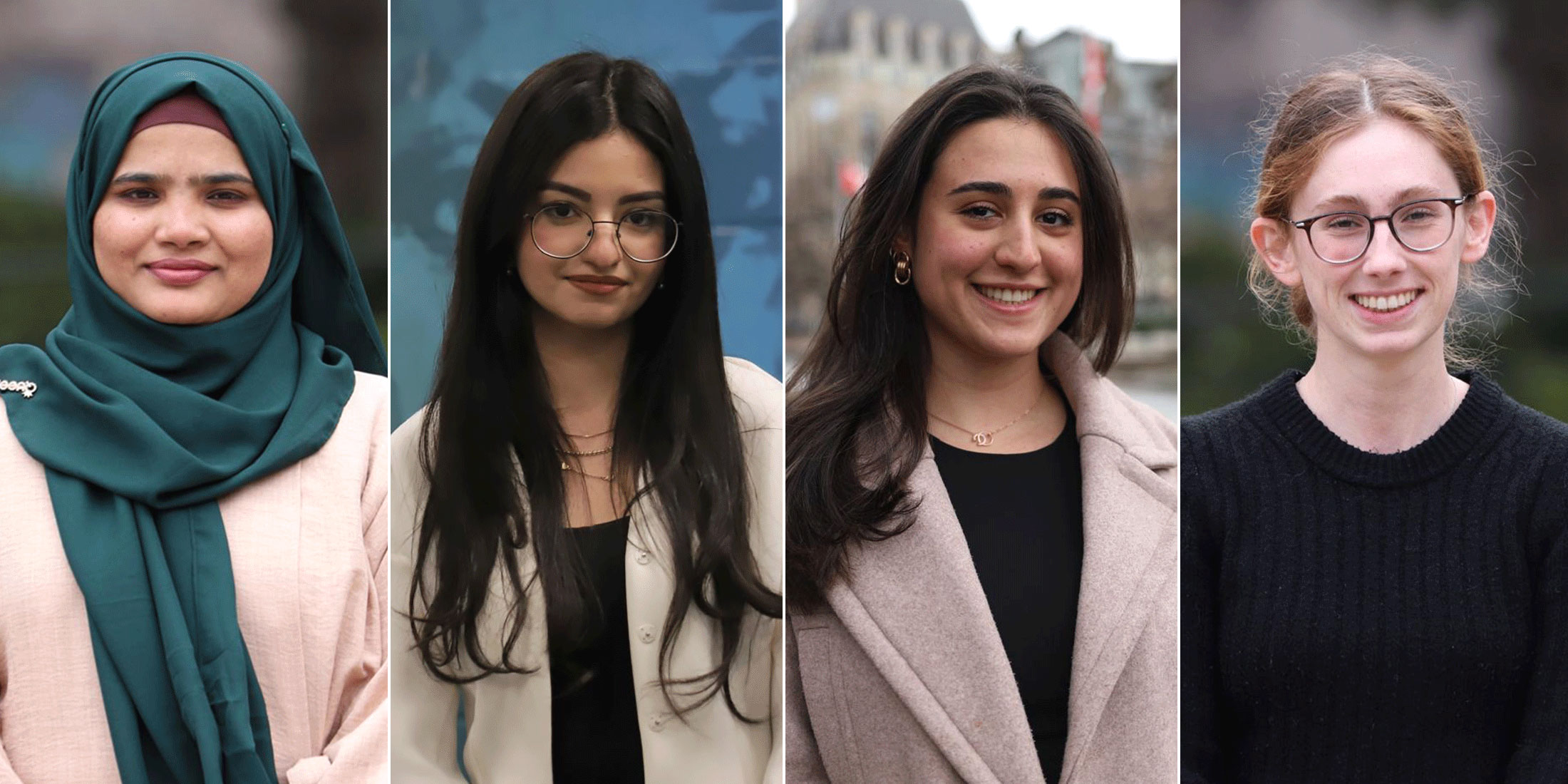
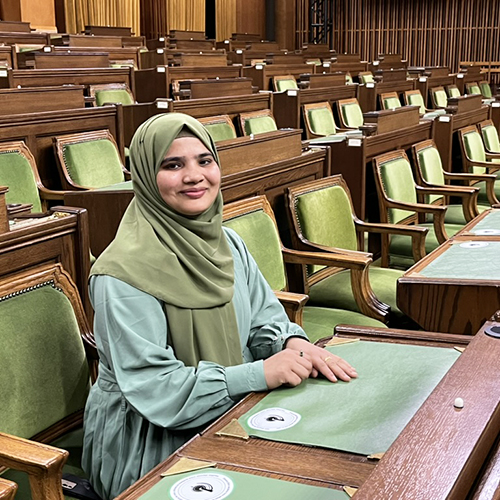
For most of her life, education was something Johar had to pursue from the margins — first as a stateless Rohingya child in Myanmar, then as a refugee in Bangladesh, and later as an undocumented student in India.
Born in Myanmar’s Rakhine State, Johar grew up under the 1982 Citizenship Law that rendered the Rohingya stateless. Her father had once held citizenship, but by her birth that right was gone. Rohingya children were restricted in school, in travel, even in the names they could use. Her father, a grocer, was repeatedly arrested.
The Rohingya, a predominantly Muslim minority, have faced decades of persecution driven by discrimination and ethnic nationalism. Hoping she might find opportunity, Johar’s parents changed her birth name, Tasmin Fatima, soon after she was born.
“When we were born, we were already stateless with no right to education, no right to freedom,” says Johar. “No matter how talented you were, as a Rohingya you didn’t get an opportunity.”
In 2005, when Johar was six, her family fled to Bangladesh and lived near the Kutupalong Refugee Camp without legal status. With no ID, there was no formal schooling and her father and brothers worked for below‑minimum wages. When authorities cracked down on undocumented residents, her father was jailed for three months.
India became the family’s next hope. At 13, Johar arrived in Haryana, then moved to Delhi in search of schooling. In 2015, she discovered the National Institute of Open Schooling (NIOS), one of the few educational pathways available to undocumented youth in India.
When Johar passed her final exams, she became the first Rohingya woman in India among 40,000 Rohingya refugees to complete NIOS Class 10, the equivalent of completing high school in North America. Her story spread across international media and was later chronicled in the book Tasmida: The Journey of a Rohingya Girl Twice Displaced.
Johar later passed an entrance exam for law school at Jamia Millia Islamia, a public university in India, but was told she needed approval from India’s Ministry of Home Affairs — approval that never came. She hid her identity again and completed an online political science degree from the University of Delhi in 2022, yet remained undocumented.
“In India, we didn’t have any document except a refugee card,” she says. “Which is equal to nothing.”
That same year, she applied to the UNHCR‑Duolingo program, an initiative designed to help refugee students access education and build career skills, despite being two years over the program’s age limit. “I wanted to test my destiny,” she says.
Johar was selected. Searching for universities that aligned with her academic background, she connected with Prospect Burma, an organization that opens pathways to higher education for students from Myanmar, which pointed her toward Laurier and ISOW. Johar applied for an ISOW scholarship and was accepted.
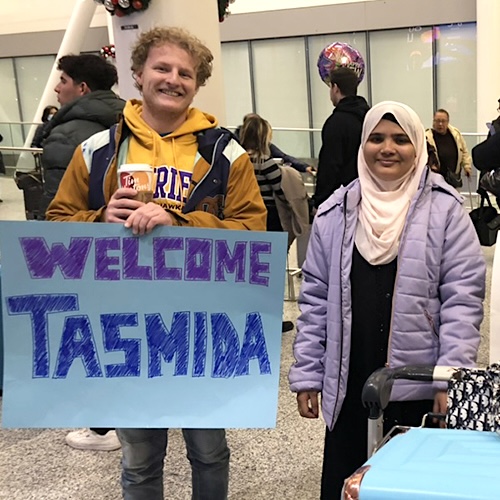
In December 2023, Johar arrived in Canada, not just as a refugee, but as a university graduate beginning again. She describes her first months in Canada as overwhelming. She had never been through a winter and had never navigated the Canadian university system.
At Laurier, Johar recently completed the requirements for a sequential degree in Global Studies, transferring credits from the University of Delhi and finishing her final 10 courses at Laurier’s Waterloo campus. More than the academics, it was Laurier’s culture of learning that stunned her after arriving. In her earlier schooling, students were expected to remain silent, speaking to teachers was discouraged, attending office hours was a sign of weakness, and asking questions meant you didn’t belong.
At Laurier, she says she was encouraged to ask questions, participate and seek support.
“They told us to speak,” says Johar. “You were allowed to express your feelings.”
Johar became an active member of Laurier’s Muslim Students’ Association, where she found a community that allowed her to practice her faith openly — something she had never experienced. Since arriving in Canada, she has also worked as a research assistant, volunteered with the YMCA teaching language classes, and served as a life‑skills support facilitator at Reception House Waterloo Region, helping newcomers navigate appointments and the settlement processes.
She has also given back to ISOW. As the first Rohingya scholar in the program, Johar knew how overwhelming the transition could be. She spent a summer interning with ISOW to prepare incoming scholars and helped bring two additional Rohingya students to Laurier in September 2025.
“When I was waiting to come to Canada, I didn’t know anything about ISOW or life in Waterloo,” says Johar. “I wanted to make it easier for others.”
Having completed her Global Studies degree requirements, Johar will graduate as part of Laurier’s spring convocation in June.
“I’m very excited,” she says. “I’m the only one in my whole family graduating like this.”
Johar’s long‑term goal is to pursue advocacy work. As a child, she wanted to be a doctor. Later, she dreamed of becoming a lawyer. Today, she hopes to continue her education — if she can secure funding as an international student — and eventually work in human rights.
“I want to raise my voice for those other kids who were in a situation like mine,” she says.
Johar says she is grateful for the opportunity provided to her by ISOW. She believes more support for the student-run organization could change even more lives.
“ISOW is the organization that changed my life,” says Johar. “It’s not just financial. It’s emotional. It’s academic. Now that I am graduating, it’s not just my achievement – it’s ISOW’s achievement. And it is my community’s achievement also. Where I come from, they say Rohingya are uneducated. But if we are given a chance, we can prove ourselves.”
Sara Aljaafari was eight years old when her family fled Syria in 2011. The decision came suddenly. Her father, who had participated in protests against the Assad regime, received a warning that he could be detained.
“We immediately packed and left the country,” says Aljaafari. “It was really difficult for us to leave everything and go.”
What followed was more than a decade of displacement in Lebanon — and a long search for stability, safety and opportunity.
“My parents really prioritized education overall,” says Aljaafari. “So my sisters and I were really focusing on that regardless of what was happening around us.”
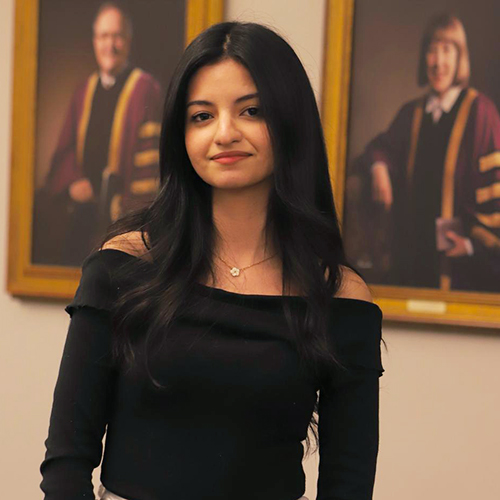
Life in Lebanon was shaped by constraints that extended beyond schooling. Syrian refugees faced restrictions on employment, residency renewal and legal status. Even basic stability required navigation of bureaucracy. For Aljaafari’s father, a medical doctor, the impact was direct.
“He tried to open a clinic and they didn’t allow him,” she says.
By the time she was preparing to finish high school, Aljaafari had already begun looking beyond Lebanon. She applied to universities abroad, searching for a place to continue her education.
That search eventually led her to Jusoor, a Syrian organization that supports refugee students in accessing postsecondary education internationally. Through Jusoor’s partnership network, she discovered ISOW, and eventually Laurier’s Data Science program.
“I read about Laurier and I really liked it,” says Aljaafari. “I knew this was what I wanted.”
Aljaafari will graduate with a Bachelor of Science at spring convocation in June and has already secured a full-time position with the multinational data company Equinix following a successful internship — a role she pursued independently.
“It took a lot of applications, a lot of work, a lot of determination,” she says. “But it’s been life changing.”
At Laurier, Aljaafari found both academic structure and professional direction in Data Science, a field that combines her strengths in mathematics and problem-solving. Her work at Equinix focuses on human resources analytics, including predictive modelling to better understand workforce trends.
As she prepares to graduate and begin full-time work, Aljaafari says the most difficult part of her journey has not been academic. It has been distance.
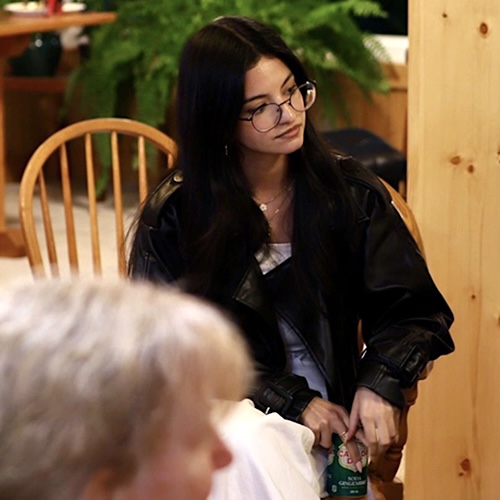
“The part that you always miss is your family,” she says. “You miss the fact that you used to live with them and you’re no longer there.”
Aljaafari’s family remains spread across countries. Her father returned to Syria following political changes in 2024, while her mother and one of her sisters — who has been accepted to study at Stanford University — remain in Lebanon to complete her sister’s schooling. Another of Aljaafari’s sisters is currently pursuing her PhD at the Massachusetts Institute of Technology.
“I’ve learned how to carry that with me while still moving forward,” says Aljaafari. “It’s a lot to navigate.”
Aljaafari says she wants people to understand that ISOW scholars are not defined by hardship.
“Scholars bring so much more than their hardship and stories,” she says. “They bring their talents, intelligence, ambition and perspective.”
When Zeyneb Ozdemir arrived in Canada at age 15, she did so without clear immigration status, a fixed academic plan, or certainty about whether she would be able to attend university at all.
Her early life had been shaped by movement across countries and shifting legal realities. Born in Brazil to a Turkish father and an Arabic mother, Ozdemir moved to Canada with her family under her mother’s student visa. But stability remained fragile.
At home, her family’s situation was tied to ongoing legal uncertainty involving her father, who had faced political persecution connected to opposition to the Turkish government. Over time, the family’s status in Canada remained unresolved, moving through refugee and humanitarian applications that were repeatedly delayed or denied.
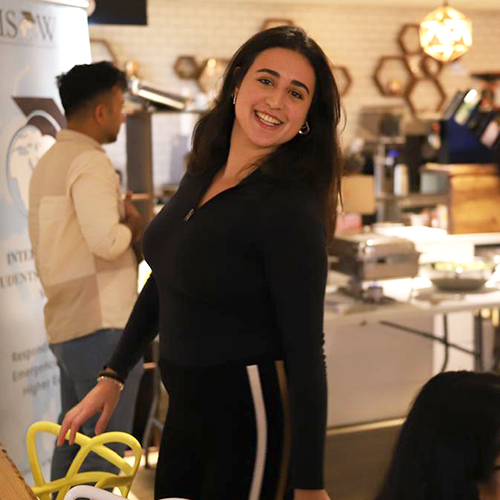
“We were really scared,” says Ozdemir. “It was life-threatening.”
Despite this instability, Ozdemir’s academic path continued forward. As she neared the end of high school, she received early acceptance to Biology at Laurier.
“I accepted the offer, but I didn’t know yet how I was going to be able to pay for tuition,” she says.
It was through a case worker that she first learned about ISOW. Shortly after, she was accepted as a scholar. Over the next four years, Ozdemir says ISOW became much more than a scholarship program.
“The thing that I love about it is that it’s a community,” says Ozdemir. “They always tried to support me in any way.”
For Ozdemir, the transition into university was not just academic — it was also cultural, linguistic and social. In high school, Ozdemir recalls being told by a teacher that she would not be able to succeed in university because of her limited English skills.
“Every person that pulls me down, it drives me to say, ‘Okay, you know what? I’m going to prove them wrong,’” she says. “I was really shy in the beginning, so I learned how to speak in public and interact with people.”
By her upper years at Laurier, Ozdemir worked as an instructional assistant in a first-year Biology course, a role that required public speaking and peer engagement.
Graduating with an Honours degree in Biology at spring convocation, Ozdemir is working toward her next goal: medical school. She has already written the Medical College Admission Test (MCAT) once and is preparing to write it again while applying to programs across Canada and internationally.
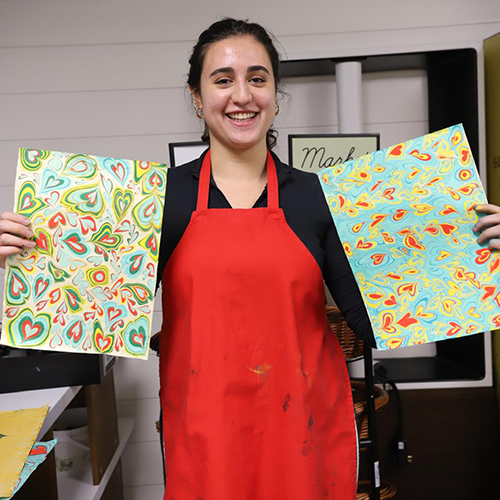
Although Ozdemir’s experience was not defined by war, she recognizes a connection with other ISOW scholars through shared understanding rather than identical histories.
“I am really different from other scholars,” she says. “I’ve never been in a war. But when we all come together, we are just one. We always have something that connects us.”
For Ozdemir, that connection lies not in the same experiences, but in overlapping values — resilience, ambition and the experience of navigating instability in different forms. After years in Canada, uncertainty over residency continues to shape daily life for Ozdemir’s family.
“We’ve been here for six years,” she says. “We applied for a refugee claim and it got declined… then we applied on humanitarian grounds, which was accepted, but we’re still waiting.”
Ozdemir’s message to herself — and to future ISOW scholars — is simple.
“Never underestimate yourself,” she says.
As Sharmaine Lichty walked through the concourse at Laurier during her first year of studies, she stopped at a booth for an organization she had never heard of before. She left thinking about it.
“I couldn’t believe that students were running an organization like a scholarship initiative for students from conflict-affected areas,” says Lichty, who is graduating at spring convocation with a degree in English and History. “I couldn’t believe it was students for students.”
That moment became the start of a four-year progression through ISOW’s leadership structure: secretary in second year, vice-president in third year, and now president in her final year. During her time as an ISOW leader, Lichty has helped grow the organization’s support systems, leading a successful student referendum campaign for increased financial support and contributing to the development of a scholarship for young Palestinian women from Gaza.
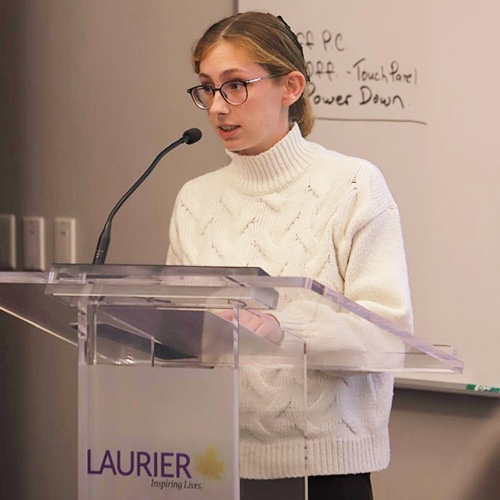
“As a history student, you study a lot of the terrible things that have happened in the past,” says Lichty. “And there’s nothing you can do about them. But then it makes me ask: what can I do about the bad things that are happening today?”
As president, Lichty works closely with faculty advisor Associate Professor Gavin Brockett and leads a team of more than 30 students involved in ISOW’s operations and scholarship programming. Much of the past year centred on preparing and executing a successful referendum campaign to increase student contributions to the initiative.
But Lichty’s involvement has extended far beyond organizational leadership.
During the past two years, she also helped develop a scholarship supporting young Palestinian women from Gaza — a project that began as research and evolved into an international collaboration involving contacts in Egypt and Jordan.
“It started with trying to understand the situation and how to most effectively build a scholarship,” she says. “Through my research, I was able to make contacts on the ground and get firsthand information about what’s actually happening.”
At the centre of ISOW’s mission, Lichty says, is the idea of education as both safety and opportunity — and of students becoming leaders once they arrive at Laurier.
“ISOW’s mission is to provide scholarships to students from conflict-affected areas to come study in safety in Canada,” she says. “And through that, giving them opportunities to become leaders on campus.”
Lichty is clear about the challenges ISOW scholars face upon arrival: adapting to a new education system, navigating a new country, and building confidence in unfamiliar spaces.
“Everything is new — how a grocery store works, how to use transportation. It’s a completely different world,” she says.
ISOW’s response is a wraparound support system that includes airport arrivals, orientation, academic support and peer mentorship. Still, what stays with Lichty most are the personal stories of ISOW scholars.
“When scholars arrive and talk about their journey, it’s very moving,” says Lichty. “As a young woman, hearing other young women talk about their experiences really hits home.”
Lichty’s work with ISOW has shaped her academic future: this fall, she will pursue a master’s degree in history at the University of Waterloo, focusing on the Israeli-Palestinian conflict. Through her experience as ISOW president, Lichty says her understanding of leadership has shifted.
“Leadership isn’t about having all the good ideas,” says Lichty. “It’s about recognizing good ideas when you hear them and helping others execute them.”