




We use cookies on this site to enhance your experience.
By selecting “Accept” and continuing to use this website, you consent to the use of cookies.
March 10, 2026
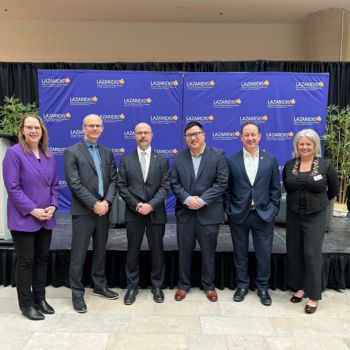
Print | PDFOn Feb. 11, 2026, the Lazaridis School of Business and Economics and Laurier Centre for Economic Policy and Research Analysis (LCERPA) co-hosted Economic Outlook 2026: The Era of Uncertainty. Hosted in Lazaridis Hall and streamed online, the event gathered more than 300 community members to explore the latest research and insights surrounding Canada’s economic future.
The event marked the highest attendance in the 35-year history of the Economic Outlook series, reflecting growing interest in Canada’s economic future.
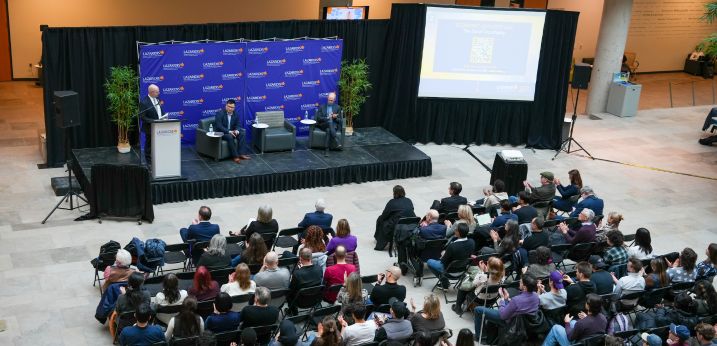
The discussion featured Professor Trevor Tombe from the University of Calgary and Brian Lewis (BA Econ ‘85), former chief economist for the Government of Ontario, currently a public policy fellow at the Munk School of Global Affairs and Public Policy at the University of Toronto.
They shared opening insights on the forces shaping Canada’s economy in the year ahead followed by questions moderated by Jeff Chan, director of LCERPA, with attendees voting on topics they wanted the panel to address. The following key themes emerged from the discussion:
Tombe noted that- forecasting the growth and health of the economy has become increasingly challenging as traditional indicators interact with emerging forces such as artificial intelligence and evolving U.S.-Canada trade relations. Leading indexes like the Signal49 Research GrowthNow and Chamber of Commerce’s Business Data Lab, offer mixed signals.
As Tombe concluded his remarks, he mentioned: “The outlook isn’t clearly strong, and it isn’t clearly weak. It’s a coin toss. It depends heavily on how uncertainty evolves and how households, firms, and policymakers respond.”
Lewis discussed how policy decisions (like U.S. tariffs) can take time to affect forecasts, noting the effects of tariffs are projected to slow growth in 2026 picking up to a modest pace in 2027 and beyond.
In his opening remarks, Tombe cited an Abacus poll reporting 67 per cent of Canadians say the cost of living is as bad now as they ever remember it. In the past two decades, productivity has slowed to 0.2 per cent per year, compared to 1.5 per cent over the previous two decades, he said.
Tombe explained that cost of living pressures are closely tied to Canada’s productivity challenges. However, productivity growth is influenced by many interrelated factors, making solutions complex and long-term.
Increasing productivity is a decades-long process, and current fiscal pressures and economic uncertainty leave less room for governments to prioritize policies supporting sustained gains.
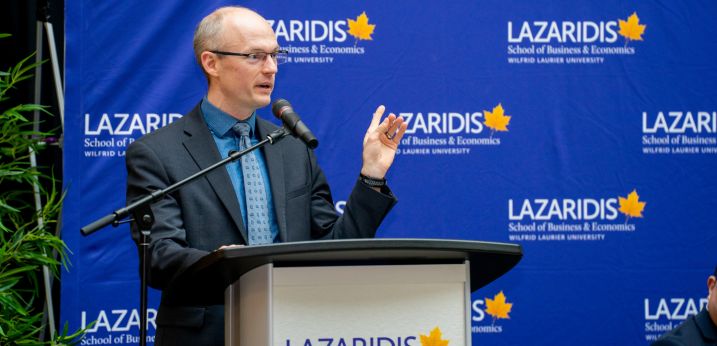
One of the most popular questions from the audience was whether AI has the potential to increase Canada’s productivity.
Tombe mentioned, “We don’t know. And we can’t know until we look back and try to estimate its contribution.” Because productivity is influenced by many factors, AI represents only one potential lever for improvement. Tombe pointed out there are many areas and tasks AI cannot help with, which will still need to be tackled by humans at least in the near future.
Lewis encouraged students in the audience to: “learn how to use it as a tool but don’t ever use it to replace doing real work... develop your critical thinking skills because this is what is going to get you ahead in your careers and will actually help you not be replaced by AI someday.”
Fiscal pressures make less space for risk. One way to decrease uncertainty is to create more economic resilience. However, being resilient requires more risk-taking, and risk-taking only increases uncertainty.
As Tombe pointed out, diversifying Canadian trade beyond the U.S. is one way to manage exposure to the risks of U.S.-Canada trade relations. However, creating these new trading partnerships creates new risks, which also makes things more uncertain.
Lewis noted policymakers in Canada are beginning to set new directions for economic policy in response to ongoing volatility. With little indication that uncertainty will ease soon, he encouraged business and academic leaders to stay prepared while remaining open to the opportunities that periods of economic change can create.
As Lewis explained, “understanding risks will be important, but equally crucial is taking clear action while remaining alert to new opportunities created by ongoing change.”
Both panellists agreed in the short term, finding ways to boost inter-provincial trade could offer a more stable path towards economic growth in Canada while U.S. policy remains volatile and unreliable.
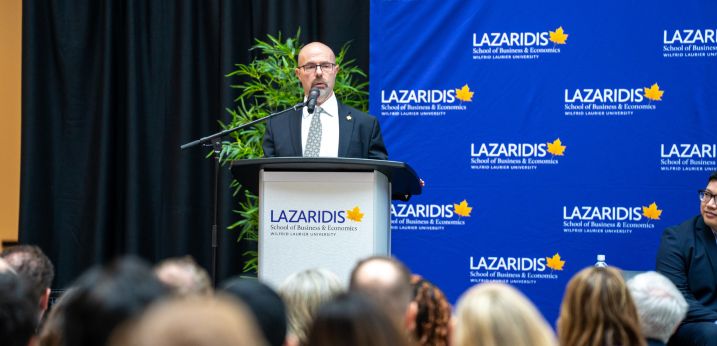
Both Lewis and Tombe noted economic uncertainty often changes behaviour across the economy. Businesses may reevaluate hiring strategies, investment priorities, and valuations as new information emerges. Individuals experience similar shifts, reconsidering career paths, education plans, and mobility as they respond to changing economic conditions.
Political instability and uncertainty are not new in the Canadian context. Their effects ultimately create both volatility and opportunity. The panellists cited computerization and the advent of the internet as other examples of great economic uncertainty in recent history.
Despite uncertainty, the panellists agreed that Canada is a global leader with access to resources and a highly educated population.
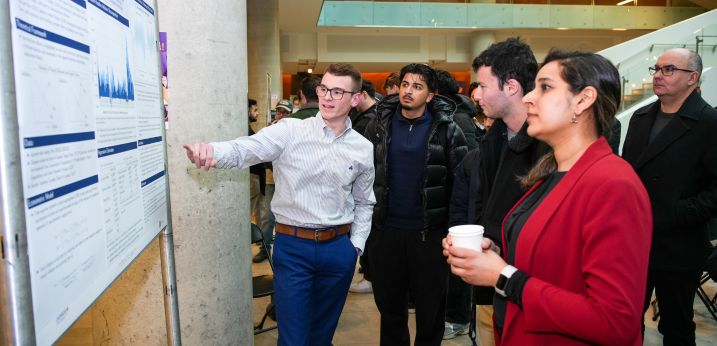
After the panel discussion, the audience came together for a networking reception to share ideas, takeaways, and more curiosity. Despite the theme of uncertainty, many shared laughs and even reported feeling a sense of optimism for the future.
Economics students presented their current research to guests at the event, adding another layer of thoughtful discussion and a visual representation of impactful economics research at the Lazaridis School.
As Tombe said in his opening remarks, “uncertainty isn’t just a feature of the economic environment today, but one we’ll likely be facing for quite some time to come.”
Thank you to everyone who attended Economic Outlook 2026 and embraced The Era of Uncertainty with us.
Economic Outlook is made possible in part by the Research Support Fund (RSF). RSF provides essential personnel funding to facilitate impactful, research-focused events at the Lazaridis School of Business and Economics.