


We use cookies on this site to enhance your experience.
By selecting “Accept” and continuing to use this website, you consent to the use of cookies.
Dec. 10, 2025
Print | PDFIn BU111: Understanding the Business Environment, first-year students at the Lazaridis School of Business and Economics at Wilfrid Laurier University learn to analyze and develop insightful strategic recommendations. The course builds the foundations of competitive analysis and critical thinking, then asks students to apply those skills early. That learning comes to life in one of the program’s signature experiences: the BU111 Live Case Competition.
This year’s case brought students face-to-face with a challenge that feels especially close to home. Cineplex, Canada’s largest film exhibitor, is working to re-engage young audiences at a time when moviegoing habits have shifted dramatically. Attendance among 18- to 24-year-olds has fallen and early streaming releases have made staying home an easy substitute. Professor and BU111 course coordinator Sofy Carayannopoulos told students, “you are the problem and the solution” since they are the very demographic Cineplex hopes to reach.
Cineplex challenged students to develop scalable, insight-driven strategies to increase monthly theatre visits among young moviegoers by 25,000 people by 2027. It was an ambitious ask, and for more than 2,000 students, it marked their first chance to tackle a live business problem using the analytical tools they had been building since September.
From among 300 BBA teams, 59 teams advanced to the semi-finals. From there, six finalist teams earned the opportunity to present their solutions to Cineplex executives.
A sudden winter storm forced the competition online with almost no notice, moving the in-person showcase to an online competition — a curveball that mirrored the uncertainty business professionals often face. It could have derailed months of preparation. Instead, it became the perfect demonstration of what the competition is designed to teach: adapt quickly, stay composed under pressure, and deliver your best work. By the time the final presentations began, nearly 300 participants were logged into Zoom, ready to learn from and support the six finalist teams.
Carayannopoulos opened with a smile and a nod to the chaos behind the scenes. “We are a very agile school,” she told the crowd. “The students handled the move online elegantly. And our IAs [Instructional Assistants] were incredible — getting breakout rooms ready, giving feedback, making sure the learning didn’t stop.”
Then came her reminder of why this competition matters, and why so many students tuned in on a Saturday morning to support the finalist teams: “There’s so much to learn by listening to your peers. The standards they set help you grow.”
Dean Kyle Murray followed, grounding the morning in the reality of what these first-year students were stepping into. “Like real life, stuff happens, and we have to adapt,” he said. “Anyone can perform when things are normal. But performing under uncertainty? That’s what sets people apart. Experiential learning gives you a chance to learn these critical skills under pressure, but with a safety net. And they are an important part of the student experience – you learn to work through complex problems, you make friends, and you grow. These moments stay with you. Congratulations to all the teams this year. Kudos to the teams competing today. Good Luck.”
With that, the spotlight shifted to the teams and their solutions to re-engage Gen Z moviegoers.
The pitches ran in rapid succession, each team bringing a fresh lens to the future of moviegoing. Here’s a quick summary in presentation order:
The finalists from Atlas Consulting — Victor Duong, Alexander Folkerts, Cameron Frost, Alyssa Lavor and Jessica Wainstein — approached the challenge from an operational and experiential angle. They proposed last-minute dynamic pricing for empty seats paired with CineVerse, immersive pop-up installations aligned with major film releases.
With 2026 expected to bring a slate of cultural juggernauts — from the Marvel Cinematic Universe to the newest Avatar release — Atlas argued that integrating experiential elements into the physical space could strengthen value perception and drive add-on spending.
The Waterloo Consulting Team — Himani Patel, Charlotte Jez, Lucas Campagnoni, Zishine Wang and Kristen Tsui — shifted the Zoom-room’s energy with NextUp Canada, a live talent showcase that transforms auditoriums into stages for emerging performers. Their concept tapped into Gen Z’s appetite for variety, community and real-time engagement and showcased strong insight into cultural behaviours.
Using Scene+ points for voting and low-stakes betting, the team created a model that could drive weekly attendance while strengthening emotional connection to local artists. “Gen Z is willing to travel and pay premiums for live events,” the team explained. “Theatres can fill that gap with something accessible, social and repeatable.”
Pinnacle Consulting — Andy Sun, Gavin Farrar, Olivia Rigitano, Prarthi Desai and Sahib Sohi — framed their pitch around a simple idea: young people want moviegoing to feel social, nostalgic and fun again.
Their three-part strategy, called Keep it REAL (Rally, Engage, ALlure), addressed core barriers and motivations:
Pinnacle presented a clear vision that grounded their recommendation in Gen Z behaviour and Cineplex’s existing strengths. Judge Stephanie Maitland reflected on the presentation: “They hit all the points — feasibility, insight and a deep understanding of the case question.”
MMD Consulting — Jonathan Geddes, Osaretin Igbinoba, Vibhaviyaa Kuppam, Matthew Samborski and Sanushan Satheesh — focused on loyalty through a digital-first lens. Their proposal, Cineplex ScreenPass, built on Scene+ data to create a more personalized and gamified app experience for young moviegoers.
By introducing crew-based challenges, tailored offers and rewards designed around Gen Z digital habits, the team positioned loyalty as an ongoing loop of engagement rather than a transactional program.
StrataPoint Consulting — Ryan Strike, Owen Butler, Josh Kotler, Cerenna Rouhani and Christian Kristo — recommended a curated weekly date-night experience, Cineplex AfterDark. They positioned Cineplex as a destination for connection, not just entertainment.
Their proposal bundled romantic films, red-carpet opportunities, lounge access and food packages into an intentional, structured evening that made planning easier for young adults. For Gen Z, who value memorable experiences and worry about the logistics of planning a night out, StrataPoint argued that Cineplex could become a turn-key solution for affordable, elevated moments of connection.
Rounding out the morning, HAWK Consulting — Jack Brownlee, Coco Muradali, Tharnika Ratheeskumar and Joshua Walker — pitched The Next Live Scene, a national strategy for screening sports and pop culture events in theatres.
Their proposal emphasized community energy, season tickets for major sports leagues, campus ambassador programs and potential partnerships with sports betting apps. For a generation priced out of live events and eager for shared excitement, HAWK argued that Cineplex is uniquely positioned to compete with both bars and streaming platforms by offering large-screen communal experiences.
Their link to past successes such as Raptors playoff watch parties, Cricket World Cup events and UFC screenings, grounded their idea in proven demand.
When the final presentation ended, Carayannopoulos closed the morning by acknowledging the strength of all six teams. “You’ve given the judges a lot to think about,” she said. “This will not be an easy decision.”
By the afternoon, the storm had passed. Students, IAs and finalists gathered in person in Lazaridis Hall room 1001 for the awards announcement — a tradition that brings the whole BU111 community back together. The IAs, who guide weekly labs and coach students through their first major case experience, filled the room with unmistakable pride. As Carayannopoulos often tells the students, the IAs become “proud parents” to the teams from their labs, celebrating every breakthrough and cheering loudly on competition day.
Judge Kevin Watts (BBA ’94), Executive Vice President of Exhibition and Location-Based Entertainment at Cineplex, and a Laurier alumnus, shared his admiration before the results were revealed. “The visuals, the confidence, the understanding of your data — you’d have crushed us in the ’90s. We were super impressed.”
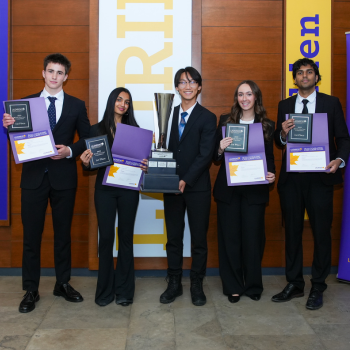
The announcements came in reverse order, heightening the anticipation. MMD Consulting was named third place, followed by Waterloo Consulting in second. When Pinnacle Consulting was revealed as the 2025 BU111 Live Case champion, the room erupted with a wave of applause. For all participants who presented, watched or supported a team, it was a moment that reflected the best of the Lazaridis School community: supportive, ambitious, collaborative and deeply committed to helping students grow.
Pinnacle Consulting described the experience as both daunting and energizing. Their strategy emerged from a process of self-reflection, critical thinking and a deep understanding of the audience they themselves represent. For most of the team, the Live Case was their first-ever case competition. “What initially seemed intimidating quickly became one of the most exciting parts of the term,” they shared. “We valued the chance to tackle a real business problem rather than simply retaining content for exams. Even the unexpected shift to online presentations challenges us to adapt and equipped us with skills we’ll carry into future terms.”
The team also shared a few highlights from a whirlwind week — from navigating unfamiliar bus routes to delivering Harry Potter references without knowing the source material, and even one teammate clanking into finals wearing their winter boots thanks to the storm. “Between the grind sessions and the chaos, we built a team as much as we built a case,” they said.