For 60 years, the Lazaridis School of Business and Economics has been a catalyst for innovation, leadership and community.
Our timeline takes you through the defining moments, from our earliest foundations to the achievements shaping the future.
Discover the people, ideas and milestones that built our legacy, decade by decade.
The Lazaridis School of Business and Economics traces its roots to 1966, when Waterloo Lutheran University announced the formation of its School of Business and Economics. Under the leadership of Director, Herman O. J. Overgaard, and with pioneering department heads such as P. Basil Healey, Glenn Carroll, and Brant Bonner, the Faculty was built on a vision of academic excellence, innovation, and strong ties between education and industry.
From the very beginning, our community embodied the principles that continue to shape the Lazaridis School’s mission and strategic plan today: elevating our exceptional student experience, amplifying our impactful research, enriching our culture of innovation and building our community of champions. The first Twin City Education-Business Day (1967) and the establishment of the Brent Scholarships by IBM Canada’s John E. Brent reflected the deep partnership with the business community—a tradition that remains central to its purpose.
This era also brought milestones in progress and inclusion. In 1968, the first three women graduated from the School and, the Stock Market Competition launched.
In 1969, the evening business administration program began with a class of over 500 working professionals. These achievements underscored a commitment to accessibility, lifelong learning, and leadership development—values that continue to drive the Lazaridis School’s pursuit of innovation and impact.
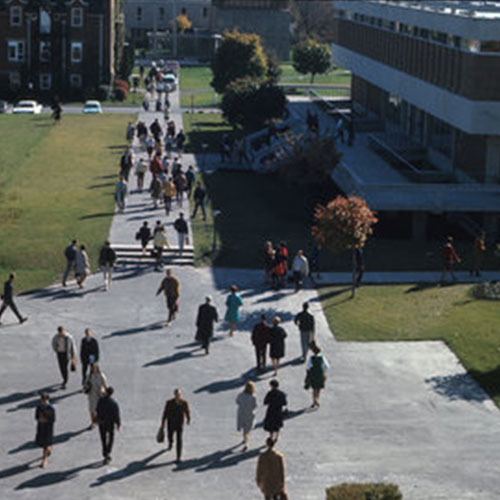
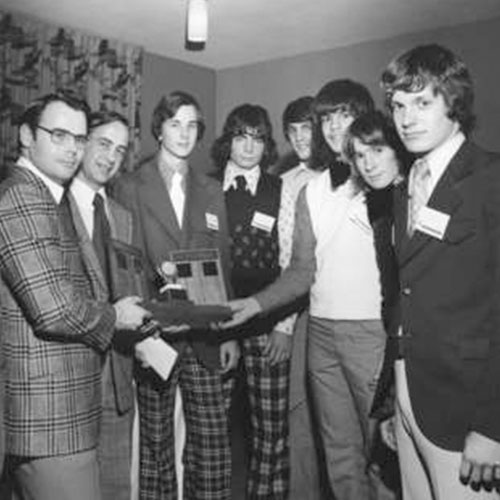
The 1970s saw growth, global engagement, and innovative learning. Under visionary Deans John R. Jenkins (1970-1974) and Max Stewart (1974-1982), entrepreneurship and collaboration grew. Executive management seminars were held in Antigua, Grenada, Ghana, and London, supported by the Canadian International Development Agency (CIDA) reflected a growing commitment to global business education, long before globalization became a defining force in management.
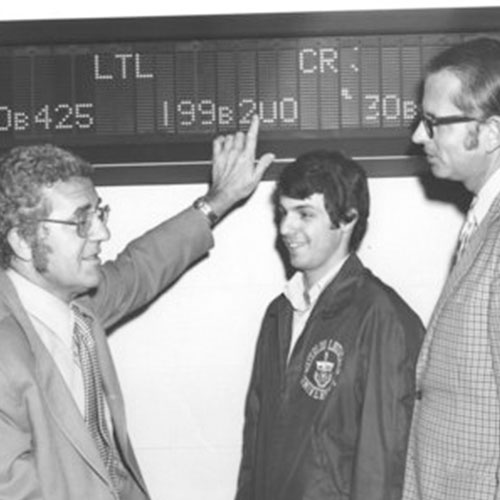
Real-world application in academic learning took root within the School of Business and Economics in the 1970s. In 1972, Canada’s only on-campus stock ticker was installed on campus supporting large-scale student-led stock market simulations.
Further pioneering models emerged during this time when Ontario’s first business co-op program launched in 1975.
The launch of the part-time Master of Business Administration (MBA) program in 1976 further advanced the school’s mission to develop leaders equipped for complex, real-world challenges.
In 1977, the first Integrated Case Exercise (ICE) was introduced – a transformative experiential learning project that quickly became a signature experience of the Lazaridis BBA program.
ICE challenged students to tackle real business problems, partner with industry and apply their learning under pressure — a tradition that continues to anchor the curriculum today.
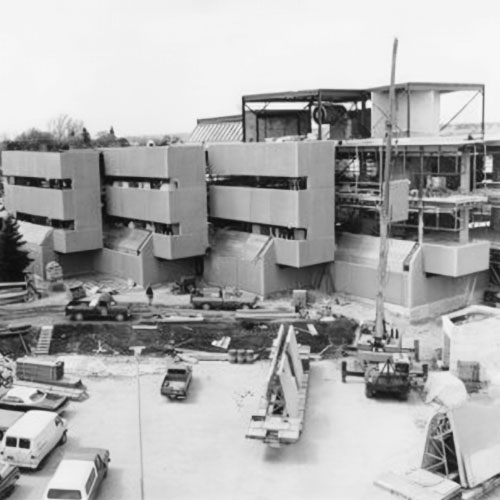
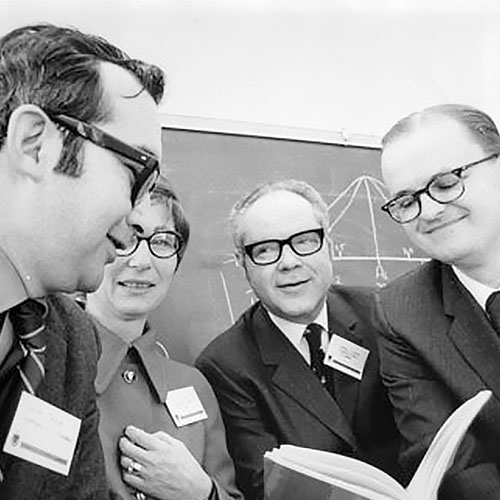
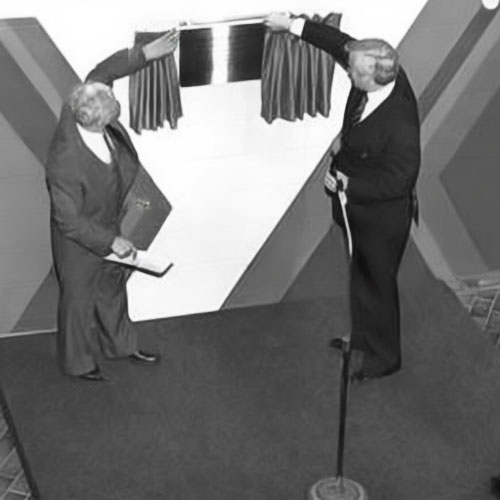
The 1980s marked a period of remarkable growth and momentum for Wilfrid Laurier University’s School of Business and Economics. The opening of the Frank C. Peters Professional Building in 1980 set a new standard, offering modern facilities that strengthened Laurier’s business community and its reputation as a centre for professional education. Under the leadership of Dean J. Alex Murray (1982-1996), faculty, students and partners continued to advanced innovation in teaching, research, and international collaboration, building on this strong foundation.
Early in the decade, access to business education expanded through partnerships with TVOntario and the 1985 Telecollege program, bringing courses to homes across Ontario through the telephone.
Experiential learning flourished: the co-op program earned its first student award in 1981, and the 1984 Integrated Case Exercise gave students their first hands-on experience with a live corporate case from Procter and Gamble.
In the 1980s, several key research and industry initiatives kicked off. The Laurier Institute for Business and Economics Studies (1983) and the Research Centre for Management of Advanced Technology (REMAT) (1985) strengthened the school’s research impact, while Dean J. Alex Murray’s Business Confidence Survey (1984) became a cornerstone of economic insight, eventually evolving into the Economic Outlook event in the 1990s.
The Executive-in-Residence program launched in 1986 bringing senior business leaders into the classroom, further connecting academia with industry.
Recognition of excellence became a defining theme. The Outstanding Business Leader Awards program was introduced in 1987, celebrating leading figures in Canadian industry and highlighting strong ties to the business community. Students continued to excel in national and international competitions, achieving top placements in Accounting and MBA case challenges.
By the end of the decade, Laurier expanded its program offerings by adding a full-time MBA program and creating the Ontario Centre of International Business—a joint initiative with York University that later became the Laurier Trade Development Centre.
In the 1990s, bold ideas and growing influence was the theme for the School of Business and Economics. Under the continued leadership of Dean J. Alex Murray (1982–1996) and later Dean Scott Carson (1996–2006), the School strengthened its reputation as a leader in applied business education and technology-driven innovation.
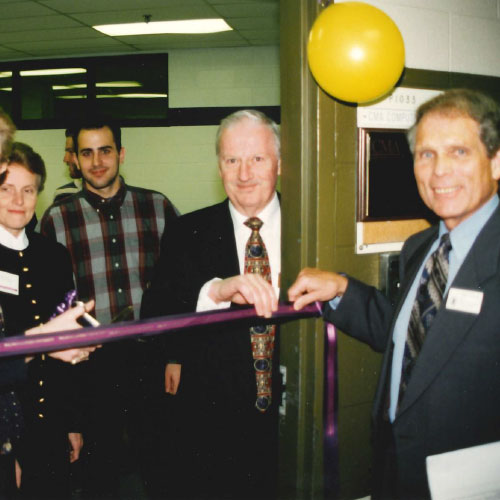
Technology and applied learning took centre stage. The launch of PRISM (Providing Resources for Information Systems Management) in the early 1990s signalled a strong commitment to integrating information systems into business education. In 1994, undergraduate business students funded a new $200,000 computer lab—the first of its kind at Laurier—giving business and economics students access to cutting-edge tools on the first floor of the Frank C. Peters Building.
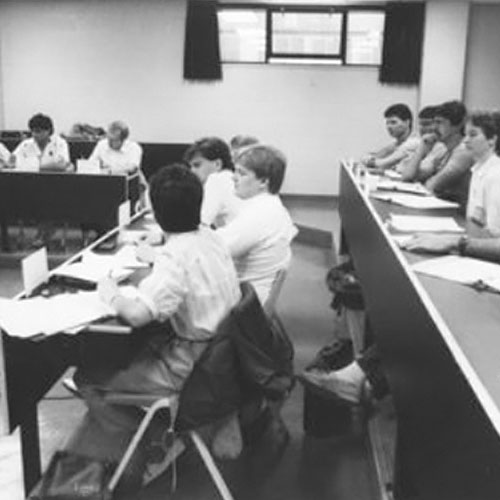
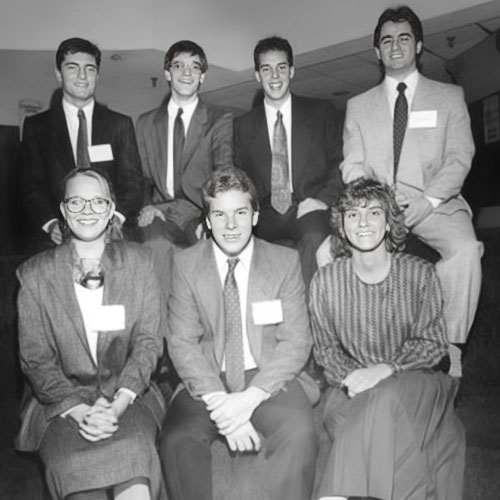
Experiential and applied learning opportunities grew. Students excelled in national and international competitions, including the InterCollegiate Business Competition, technology case competitions, and the Nestlé Canada MBA Case Competition. Programs like the Integrated Case Exercise and the CMA–Laurier management training partnership, which blended academic study with hands-on professional skill development allowed students to apply classroom theory to real-world challenges.
Graduate programming expanded in impactful ways. The full-time MBA, originally launched in the 1980s, was reconfigured to become Canada’s first one-year full-time MBA program. In 1997, a part-time Toronto MBA launched to better support working professionals downtown Toronto. The school also launched the Master of Arts in Business Economics (MABE)—Canada’s first graduate program of its kind—and introduced the country’s first English-language diploma in Financial Planning, accredited by the Financial Planners Standards Council of Canada.
The School of Business and Economics continued to grow globally, delivering business programs internationally in Trinidad and Tobago, and welcoming international student cohorts.
Technological innovation became a priority, with Canada’s first e-commerce course (BU492: Marketing Electronic Business) and a partnership with the Certified Management Accountants – enabling students to earn professional accounting designations alongside graduate degrees.
Partnerships with industry emphasized applied research and practical business solutions. The Laurier Trade Development Centre introduced an innovative PC-based software package that gave Canadian business leaders streamlined access to global trade resources. The founding of the Financial Services Research Centre reinforced the school’s growing role in financial services research and industry collaboration.


The 2000s marked a powerful period of growth for Wilfrid Laurier University’s School of Business and Economics. Under the leadership of Dean Scott Carson and later Dean Ginny Dybenko (2006–2011), the school strengthened its international presence, expanded graduate education and deepened its commitment to entrepreneurship.
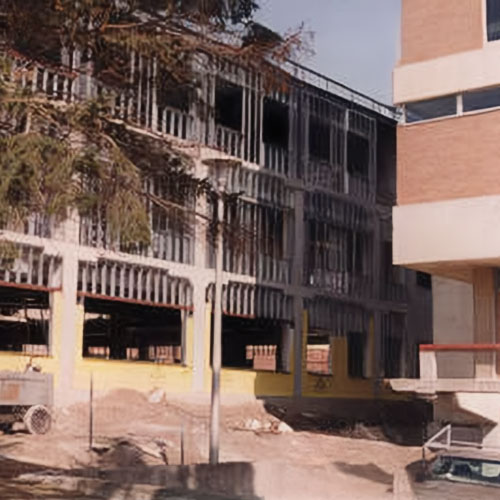
Construction began on the Schlegel Building in 2001, creating a new academic space to support Laurier’s growing business programs. In 2003, the Schlegel Centre for Entrepreneurship opened with major donor support, creating a hub for innovation, social entrepreneurship, and student ventures. The New Venture Competition, a project in first-year business courses, engaged more than 600 first-year students, and the Student Connections Program (2002) partnered with government agencies and corporate sponsors to help small and medium-sized businesses adopt digital tools – an early example of Laurier’s hands-on, community-focused approach.
The decade saw the launch of several major programs, including also introduced the Business Administration and Mathematics double degree with the University of Waterloo and the PhD in Management, MBA Co-op Program, and the Master of Finance Co-op Program.
Technology and research initiatives advanced significantly. Laurier was the first business school in Canada to integrate BlackBerry® devices into its MBA curriculum and launched the groundbreaking MBA Mobile e-learning Pilot (2009), developed with Rogers Wireless, integrating BlackBerry smartphones into the curriculum and pushing the boundaries of digital learning long before mobile technology dominated the business world.
Recognition and student success followed. In 2004, the School of Business and Economics achieved AACSB International accreditation, placing it among the world’s leading business schools and one of Canada’s first business programs to earn this accreditation. The prestigious Aspen Institute also recognized the school’s MBA program, ranking it among the Top 100 in the world in New York City. Students excelled nationally, including being named JDC West Ontario School of the Year in 2009. The Leadership in Business Conference (The LINK) launched in 2003 introducing high school students to university-level, case-based learning and strengthening our community presence.
During the 2010s, under Dean Ginny Dybenko and Dean Micheál Kelly (2012-2022), the Faculty experienced significant growth in academic programs, research strength, and global influence. Our faculty and program teams introduced pioneering programs, including Canada’s first Executive Master's of Science in Technology Management (EMTM), the International MBA, Master of Finance, Master of Science research-based programs, and the Bachelor of Business Technology Management, which formally joined the Lazaridis School during this period. Each initiative strengthened our focus on experiential and applied learning, preparing graduates for an increasingly technology-driven economy.
Entrepreneurship and innovation took on new momentum. Major philanthropic investments, including a transformational $20-million gift from Mike Lazaridis in 2015, led to the naming of the Lazaridis School the creation of the Lazaridis Institute for the Management of Technology Enterprises and the opening of Lazaridis Hall in 2016. The Laurier LaunchPad, StartUp Fund and Graduate Student Investment Fund gave students access to capital, mentorship and hands-on venture experience. The Schlegel Centre evolved into the Schlegel Centre for Entrepreneurship and Social Innovation, while the Lazaridis ScaleUp Program helped high-growth Canadian companies compete globally.
Lazaridis’ global presence expanded through strategic initiatives and international partnerships. The community joined the Global Business School Network (GBSN), became a member of the Principles for Responsible Management Education (PRME), established Dean’s Advisory Councils in Calgary, New York, Ottawa, Toronto, and Silicon Valley, and cultivated new international partnerships. The School also earned top rankings from The Globe and Mail, which recognized the School of Business and Economics among leaders in quality education and career preparation and The Princeton Review which named it one of “The Best 300 Business Schools” in the world, reinforcing its standing as a globally recognized institution.
Facilities and research capacity expanded to match the school’s ambition. Lazaridis Hall opened as a LEED-Gold Certified, award-winning facility recognized with a Civic Trust Award for sustainable design. New resources—including Bloomberg Terminals, the Consumer Research Lab, and advanced data analytics tools—elevated experiential learning and research across disciplines.
The decade showcased strong student achievement, with Laurier students excelling in national and international competitions such as JDCC, the Bank of Canada Governor’s Challenge, and major case competitions.
In brand and marketing, the school strengthened its leadership with the creation of the chair in Brand Communications in 2011, made possible by a $1.9-million investment from 45 leading Canadian brands and marketing professionals. Faculty research was also a highlight, with awards including Canada Research Chairs and Early Researcher Awards, while the Lazaridis Institute launched initiatives like the national scale-up data platform, supporting Canadian business growth.

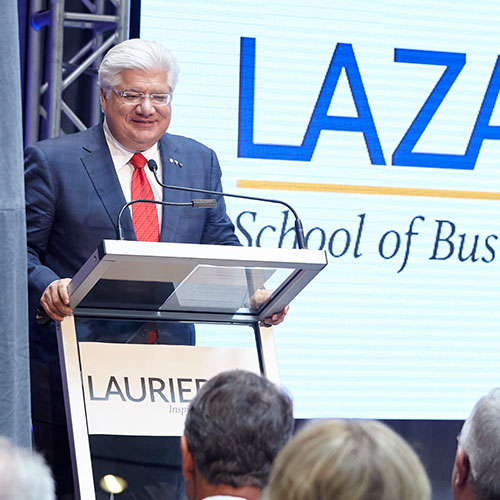

The 2020s have been defined by rapid change, and the Lazaridis School has responded by deepening its commitment to experiential learning, impactful research and innovation-driven community building. As the decade began amid a global pandemic, faculty, students and staff quickly reimagined how learning happens — strengthening digital infrastructure, expanding online and hybrid learning, and creating new opportunities for students to engage with industry, research and community partners in meaningful ways.
Innovation and entrepreneurship continued to thrive through initiatives that connected learning with real-world impact. Through the Lazaridis ScaleUp Program, more than 60 ventures collectively raised more than $1 billion in capital, reinforcing the school’s role in supporting Canadian entrepreneurship and economic growth. The Women Entrepreneurship Centre (WEC), launched in 2020, expanded access to mentorship, training and community for women entrepreneurs across Canada. In 2021, WEC introduced the Indigenous Women’s Entrepreneur Program, creating new pathways for Indigenous entrepreneurs and strengthening inclusive innovation ecosystems nationwide.
Research excellence remained a defining strength of the Lazaridis School throughout the decade. Lazaridis ranked among the top 10 in Canada and 47th globally in accounting research, while faculty secured more than $5.4 million in Tri-Agency funding in 2025 to advance research with real-world application. Partnerships with CN Rail, Boast.AI and the Balsillie School of International Affairs expanded opportunities for students and faculty to collaborate on experiential and applied research initiatives.
The creation of the Intellectual Property Lab further strengthened the school’s focus on innovation, preparing students to lead in Canada’s evolving digital economy. A transformational $5 million gift from Jim Balsillie established the Digital Governance Initiative, advancing research and national conversations around productivity, technology and Canada’s future competitiveness.
In 2024, Kyle Murray began a new chapter of leadership as Dean of the Lazaridis School. Through a revitalized strategic plan centred on innovation, collaboration and community impact, students are gaining more opportunities to learn by doing, collaborate across disciplines and engage with complex global challenges — preparing graduates to thrive in a rapidly changing world while advancing research with real-world impact.
In 2026, the Lazaridis School launched a new MBA in Sports Management in partnership with the Global Institute of Sport, further expanding experiential and industry-connected learning opportunities in one of Canada’s fastest-growing sectors. Delivered in Toronto, with classes hosted at iconic venues including BMO Field and Scotiabank Arena, the program reflects the school’s commitment to innovative business education and preparing leaders for evolving industries.
Building on a legacy of academic excellence, entrepreneurship and global perspective, the Lazaridis community looks ahead with curiosity and purpose, shaping a future where collaboration, learning and leadership create meaningful impact.