




We use cookies on this site to enhance your experience.
By selecting “Accept” and continuing to use this website, you consent to the use of cookies.
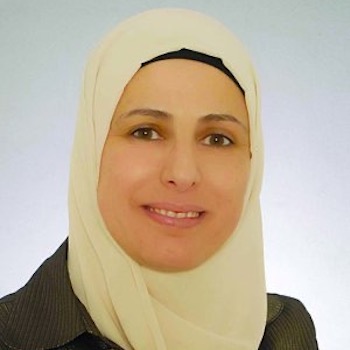
Associate Professor (effective July 1, 2026)
Lyle S. Hallman Faculty of Social Work
Wilfrid Laurier University
she/her
My work is carried out on the traditional territory of the Neutral, Anishnaabe, and Haudenosaunee peoples. I am committed to solidarity with Indigenous struggles for justice and self-determination.
I came to social work through architecture. Trained to build spaces, I now study how space is used to dispossess—and how communities resist. This dual training—alongside my lived experience and years of work on the ground with impacted communities—shapes everything I do. I hold a Bachelor of Architecture from An-Najah National University (Palestine), a Master of Social Work from McGill University, and a PhD in Social Work from McGill University.
I am a Palestinian, Muslim, first-generation immigrant, mother, and scholar-practitioner. I was born and raised under military occupation. I have witnessed how settler-colonial violence shapes every dimension of life—home, land, education, safety, belonging—and how it reverberates across generations. I have also witnessed sumud: the everyday, relentless practices of steadfastness through which families refuse erasure. My work is not something I study from a distance. It is something I live.
Before joining Wilfrid Laurier University in 2018, I practiced for nearly a decade as an architect and urban planner in Palestine, designing community-centered spaces for marginalized populations while watching those same spaces be threatened with demolition. I then worked for four years as a social worker and clinical case manager with families facing home demolition, forced displacement, intergenerational grief, and systemic poverty under military occupation. Alongside that clinical work, I volunteered with Palestinian communities at acute risk of displacement—Bedouin and herding communities in so-called Area C—conducting door-to-door outreach, facilitating empowerment workshops, and supporting community-led planning. That frontline experience taught me that ethical practice demands critical adaptation of Western models, attention to structural violence, and relationship-based accountability.
That same commitment now shapes my work with migrant communities in rural Southern Ontario, where I partner with legal clinics to document and address the barriers faced by undocumented migrants, international students, and temporary workers navigating systemic precarity. Whether in Palestine or Canada, my research asks the same question: how does spatial injustice operate, and how do communities resist?
But it was my lived experience as a racialized Palestinian woman—an Arab and Muslim scholar navigating the academy in the West—that taught me how power operates through knowledge itself: who gets to speak, whose suffering is visible, and whose resistance is erased. That knowledge is not a liability. It is my expertise.
In 2026, I was promoted to Associate Professor with tenure at Wilfrid Laurier University. My research program is unified by a commitment to spatial justice. My pedagogy is guided by Istinhād (استنهاض)—a Palestinian epistemological framework of collective awakening and moral responsibility to address injustice.
What I do, I embody. What I teach, I have lived. What I research, I owe to the communities who have walked alongside me—in Palestine and in Canada—whose struggles for dignity and self-determination continue to guide my work.
My research is unified by a commitment to spatial justice: understanding how structural violence is written onto land, homes, and institutions, and how communities resist through practices of sumud, collective care, and decolonial knowledge-making.
I examine how settler-colonial violence shapes housing rights, displacement, and resistance. My doctoral dissertation, Challenging Spatial Oppression in a Context of Housing Rights Denial: A Case Study in So-Called Area C, West Bank, Palestine (FRQSC-funded, $60,000), documented how Palestinian communities resist home demolition and forced displacement through everyday practices of sumud. This work emerged from a decade-long partnership with the Palestinian Ministry of Local Government and UN-Habitat and was featured in the National Film Board documentary Grassroots in Dry Lands (2015). A monograph based on this research is under review. Current work extends this framework to Gaza through the pending Architecture of Sumud project (Doha Institute), exploring co-design for restorative reconstruction.
🔗 Doctoral dissertation | Grassroots in Dry Lands — Official NFB Film Page| CRSP Talk Podcast: Research in settler colonial contexts
I lead Precarity, Everyday Lives, and Access to Justice (Law Foundation of Ontario, $25,000), a community-based study examining systemic barriers faced by undocumented migrants, international students, and temporary workers in rural Southern Ontario. In partnership with the Community Legal Clinic—Brant, Haldimand, and Norfolk, this project has produced practitioner briefs, a research report, and a forthcoming podcast series, and is shaping legal aid service models.
🔗 CRSP Project Page: Bridging the Justice Gap
I co-founded the Instructor Capacity for Equity and Decolonization (ICED) initiative, developing the Instructor Self-Assessment Tool (ISAT) to support faculty in operationalizing decolonial and anti-racist pedagogy. This work has been supported by $30,000+ in internal funding and published in the Journal of Transformative Education (2025). My current research examines the experiences of Palestinian, Muslim, and Arab scholars and students navigating the "policing of solidarity" during geopolitical crises, with recent publications in Abolitionist Perspectives in Social Work (2025).
🔗 Building Faculty Efficacy in Teaching (Journal of Transformative Education, 2025) | Phenomenologies of Silence (Abolitionist Perspectives, 2025) | Race and Rights Podcast (Part I) | Race and Rights Podcast (Part II) | Islamophobia Studies Podcast
| Role | Project | Funder | Amount | Status |
|---|---|---|---|---|
| Principal Investigator | Exploring the Experiences of Palestinian, Muslim, and Arab Women Scholars in Social Work Academia During Geopolitical Conflict. | — | — | In progress (2024–2026) |
| Principal Investigator | Cultivating Culturally Responsive Classrooms | SSHRC Explore Grant | $7,000 | In progress (2025–2026) |
| Co-Investigator | Repression of Palestine Solidarity in Schools of Social Work | — | — | In progress (2026–2027) |
| Principal Investigator | Precarity, Everyday Lives, and Access to Justice | Law Foundation of Ontario | $25,000 | Completed (2023–2025) |
| Principal Investigator | Challenging Spatial Oppression in a Context of Housing Rights Denial (Doctoral research) | FRQSC Québec Merit Scholarship | $60,000 | Completed (2015–2018) |
| Co-Investigator | Building Instructor Capacity for Equity and Decolonization | WLU Early Career Grant | $14,996 | Completed (2023–2024) |
| Co-Investigator | Service Needs of Sexually & Gender Diverse Muslims and Their Families | SSHRC Partnership Engage Grant | $24,204 | Completed (2020–2022) |
| Co-Investigator | Working Through Security | SSHRC Connection Grant | $19,356 | Completed (2020–2021) |
| Co-Applicant | Anti-Racism and Society Online Course | E-Campus Ontario | $73,700 | Completed (2021–2022) |
| Role | Project | Funder | Decision |
|---|---|---|---|
| Principal Investigator | Researching the Exception: Co-Creating a Trauma-Informed, Anti-Colonial Research Framework with PMA Students | SSHRC Insight Development Grant | Summer 2026 |
| Principal Investigator | The Architecture of Sumud: Co-Designing for Agency, Dignity, and Restorative Reconstruction in Gaza and the West Bank | Doha Institute Postdoctoral Fellowship | Summer 2026 |
| Co-Applicant | Xenophobic Political Discourse as a Structural Determinant of Health | CIHR Project Grant | Summer 2026 |
| Collaborator | Reproductive Agency in Turbulent Times: Palestinians' Family-Making Decisions in the Context of Political Violence | SSHRC Insight Development Grant | Summer 2026 |
| Year | Award |
|---|---|
| 2018 | FRQSC Postdoctoral Fellowship (declined) — Fonds de recherche du Québec – Société et culture |
| 2015–2018 | Québec Merit Scholarship for Foreign Students (FRQSC) — Doctoral research |
| 2014–2015 | Pierre Elliott Trudeau Foundation PhD Scholarship (finalist, one of 23) |
| 2014–2015 | Civil Society Scholar Award — Open Society Foundations |
| 2014–2015 | Hazeldine Smith Bishop Fellowship — McGill University |
| 2013–2015 | P.E.O. International Peace Scholarship |
| 2013–2014 | Margaret McNamara Memorial Fund — World Bank |
| 2012–2014 | Global Supplementary Grant — Open Society Foundations |
| 2012–2013 | Hazeldine Smith Bishop Fellowship — McGill University |
| 2007–2009 | International MSW Graduate Fellowship — McGill University / CIDA / Quebec Ministry of International Relations |
| Year | Award |
|---|---|
| 2017–2018 | International Graduate Mobility Award — McGill University (Internship at MoLG & UN-Habitat, Palestine) |
| 2017–2018 | Lotte Marcus Sheldon Research Award — McGill University |
| 2016–2017 | Social Work Graduate Award — McGill University |
| 2015–2016 | Graduate Excellence Award in Social Work — McGill University |
| 2015–2016 | Graduate Research Enhancement and Travel Award — McGill University |
| 2014–2015 | Lotte Marcus Sheldon Research Award — McGill University |
| 2014–2015 | Graduate Excellence Award in Social Work — McGill University |
| 2012–2013 | MCHRAT Graduate Award — McGill University |
| 2012–2013 | Graduate Excellence Award in Social Work — McGill University |
I welcome inquiries from prospective graduate students (MSW and PhD) who are interested in research at the intersections of spatial justice, forced displacement, migrant legal precarity, decolonial methodologies, and anti-racist pedagogy.
I am particularly interested in supervising students who wish to engage with:
Settler colonialism, housing rights, and sumud (steadfastness)
Migrant access to justice, precarious legal status, and rural service delivery
Decolonial, community-based, and arts-based research methods
Anti-racism, Islamophobia, and institutional accountability in higher education
Qualitative research methods, including constructivist grounded theory and participatory approaches
I currently serve on dissertation committees for PhD students at Wilfrid Laurier University and McGill University. I have supervised over 20 graduate and undergraduate Research Assistants and Teaching Assistants, providing training in qualitative data analysis (NVIVO), community-based research, and knowledge mobilization.
I am committed to mentoring students as co-creators of knowledge, not just assistants. My research projects—including Precarity, Everyday Lives, and Access to Justice and the Instructor Capacity for Equity and Decolonization (ICED) initiative—have provided paid research opportunities for MSW and PhD students, with training in:
Qualitative interview design and analysis
Community-based participatory research
Decolonial and anti-colonial methodologies
Practitioner briefs, podcast production, and other knowledge mobilization formats
If you are a student whose research interests align with mine, please reach out. I would be delighted to discuss potential supervision, research assistant positions, or collaborative projects. I am especially committed to supporting students from equity-deserving groups, including Palestinian, Muslim, Arab, and first-generation students.
Dwaikat-Shaer, N., Baksh, A., Elkassem, S., & King, B. (2025). Phenomenologies of Silence: On the Palestine Exception and the Complicity of Social Work Academe. Abolitionist Perspectives in Social Work, 3(2). https://doi.org/10.52713/ye2f7233
Dwaikat-Shaer, N., Iqbal, S., Curry-Stevens, A., Kuron, L., Tang, L., Wang, X., & Taylor, D. (2025). Building Faculty Efficacy in Teaching: Bringing Equity and Decolonization into Focus. Journal of Transformative Education. https://doi.org/10.1177/15413446251371056
Elkassem, S., King, B., Dwaikat-Shaer, N., & Baksh, A. (forthcoming). Gaza, Genocide, and the Politics of Weepy Universalism in Social Work. Canadian Association of Social Work Education. (Special issue: "When the Eyes Become the Organ for Weeping and Not for Seeing: Social Work(ers) Witnessing Global Violence")
Dwaikat-Shaer, N. (2022). Challenging Spatial Oppression in a Context of Denied Housing Rights: A Case Study in So-Called Area C, West Bank, Palestine (Doctoral dissertation). McGill University. https://escholarship.mcgill.ca/concern/theses/ww72bh72r
Al-Shaer, N. E. M., Oun, T. N. S. A., & Dwaikat-Shaer, N. (2022). Adopting Women's Quotas as a Necessity to Empower Women in the Arab World with Special Reference to the Social and Religious Factor. Journal of Positive School Psychology, 6(2), 5877–5889.
Larios, L., Hanley, J., Salamanca, M., Henaway, M., Dwaikat-Shaer, N., Ben-Soltane, S., & Eid, P. (2020). Engaging migrant care workers: Examining cases of exploitation by recruitment agencies in Quebec, Canada. International Journal of Migration and Border Studies, 6(1/2), 138–157. https://doi.org/10.1504/IJMBS.2020.108690
Hanley, J., Salamanca, M., Larios, L., Henaway, M., Dwaikat-Shaer, N., Ben Soltane, S., & Eid, P. (2018). Transportation and Temp Agency Work: Risks and Opportunities for Migrant Workers. Cahiers du géographie québécois, 62(177). https://doi.org/10.7202/1068740ar
Hanley, J., Larios, L., Salamanca, M., Henaway, M., Dwaikat-Shaer, N., Ben-Soltane, S., & Eid, P. (2017). Gender dynamics of temporary placement agency work: (Im)migrants, know your place! Canadian Diversity, 14(2), 37–42.
Dwaikat-Shaer, N., & El-Daly, J. (2026). Precarity, Everyday Life, and Access to Justice: The Experiences of Migrants in Southern Rural Ontario (Grant #1596-22). Law Foundation of Ontario.
Dwaikat-Shaer, N. (2011). Inadequate Housing: Its Effects on Quality of Life for Disadvantaged People. Community Service Centre, Nablus, Palestine.
Dwaikat-Shaer, N. (2010). Social Impact Assessment for Emnaizl Solar Energy Systems. Energy Research Centre / SEBA, Nablus, Palestine.
My teaching is grounded in the entirety of who I am and what I have lived: being born and raised under military occupation; training as an architect to build spaces, then witnessing those same spaces be threatened with demolition; intensive micro-practice with families navigating military occupation, forced displacement, intergenerational grief, and systemic poverty; qualitative research in communities at acute risk of forcible transfer; volunteering alongside Bedouin and herding communities at acute risk of home demolition in so-called Area C; and navigating the academy as a Palestinian, Muslim, first-generation immigrant woman. Every role I have held—architect, social worker, community practitioner, volunteer, scholar—shapes how I teach. Every community that has trusted me shapes what I know.
That lived and practiced foundation taught me that ethical direct practice demands more than clinical technique. It requires critical consciousness, relational capacity, and the courage to sit with complexity.
My pedagogy is guided by Istinhād (استنهاض)—a Palestinian epistemological framework of collective awakening and moral responsibility to address injustice. I invite students into what I call "generative struggle": the productive discomfort necessary for ethical unlearning. My classroom is a relational space where we co-construct knowledge, practice accountability, and develop the critical reflexivity essential for justice-oriented practice.
I have developed and taught courses across undergraduate and graduate curricula that centre historically marginalized voices—Indigenous, Black, Palestinian, queer, and Global South scholars.
| Course | Level | Description |
|---|---|---|
| SK210: Anti-Racism and Social Work | BSW (mandatory) | Developed to address a curricular gap; now foundational for all second-year students. Moves beyond "celebratory diversity" to structural analysis and decolonial praxis. |
| SK322: Qualitative Research Methods | BSW | Reimagined to foreground arts-based, decolonial, and participatory methods, replacing high-stakes quizzes with experiential assignments such as ethnographic observation and collaborative data analysis. |
| SK431: Responding to Global Crises | BSW (elective) | Redesigned from traditional International Social Work into a decolonial, justice-oriented framework that critiques charity-based paradigms and centers Global South agency. Led to an invitation from Fernwood Publishing for a related book project. |
| SK421: Social Movements and Social Justice | BSW (elective) | Centers Indigenous worldviews, Black and Global South perspectives, and abolitionist praxis. Includes experiential learning through participant observation at solidarity events. |
| SK501: Community Organizing and Group Practice | MSW (graduate) | Integrates spatial justice frameworks into community practice. Students learn to analyze how space shapes organizing and how communities build collective power. |
| SK632: Interpersonal Anti-Racism / Diversity and Inclusion in Field Education | MSW (graduate) | Prepares students for reflexive, accountable practice through positionality work, critical feedback practices, and case-based learning. |
Institutional Service
|
Role |
Committee / Initiative |
Dates |
|
Member |
PhD Committee (FSW) |
Present |
|
Member |
Graduate Awards Committee |
Present |
|
Member |
Promotion and Tenure Committee |
Present |
|
Member |
BSW Equity Committee (founding member) |
2019–2022 |
|
Member |
University Faculty Council Nominating Committee |
2023–2025 |
|
Member |
Copyright Advisory Committee |
2023–2025 |
|
Judge |
Collegiate Leadership Competition |
2025, 2026 |
|
Member |
FSW Strategic Planning Committee |
2025–2026 |
|
Member |
FSW Research Series Planning Committee |
2024 |
|
Member |
BSW PTAC & Petition Committee |
2018–2024 |
|
Member |
WLUFA Equity Committee |
2020–2022 |
|
Co-host |
SSW 2+2 Information Session |
2024 |
Community Engagement
|
Role |
Organization |
Dates |
|
Steering Committee Member |
Faith Network for the Canadian Alliance to End Homelessness |
Present |
|
Board Member |
Brantford Palestinian Association |
Present |
|
Direct Resettlement Support |
Gaza families arriving in Canada under special measures |
Present |
|
Volunteer Consultant |
Ministry of Local Government (MoLG) / UN-Habitat, Palestine |
2015–2021 |
I am committed to mobilizing knowledge beyond academic audiences through documentary film, podcasts, practitioner briefs, and community reports.
| Title | Year | Role | Link |
|---|---|---|---|
| Grassroots in Dry Lands | 2015 | Featured practitioner (social worker in Palestine) | NFB Film Page |
Produced by the National Film Board of Canada, this feature-length documentary follows three social workers in Palestine, Jordan, and Israel working to empower war-scarred communities. My practice with families facing home demolition and forced displacement in Nablus is a central focus of the film.
| Title | Role | Topic | Link |
|---|---|---|---|
| The Race and Rights Podcast (Part I) | Guest | Anti-Palestinian, anti-Arab, and anti-Muslim racism | YouTube |
| The Race and Rights Podcast (Part II) | Guest | Confronting silence on anti-Palestinian racism | YouTube |
| The Islamophobia Studies Podcast | Guest | Intersectional approaches to Islamophobia | YouTube |
| CRSP Talk (Episode 20) | Guest | Research in settler colonial contexts: A conversation on Palestine | CRSP Page |
| CRSP Talk (forthcoming) | Host/Producer | Navigating the system: Barriers and bridges to legal aid for precarious migrants | In production |
| Title | Audience | Link |
|---|---|---|
| Precarity, Everyday Life, and Access to Justice: The Experiences of Migrants in Southern Rural Ontario (2026) | Legal aid organizations, policymakers | Law Foundation of Ontario |
| Practitioner briefs (2) | Community Legal Clinic — Brant, Haldimand, Norfolk | Available through CLC-BHN |
| Date | Presenter(s) | Title | Conference | Location |
|---|---|---|---|---|
| 2026 | Baksh, Elkassem, King, Dwaikat-Shaer | Gaza, genocide, and the politics of weepy universalism | Decolonizing Conference (OISE) | Toronto, ON |
| 2025 | Dwaikat-Shaer, Elkassem, Baksh, King | The Selective Justice of Academia: Islamophobia, Palestine, and the Unspoken Politics of Solidarity | IISRA Conference | Granada, Spain |
| 2025 | Dwaikat-Shaer, El-Daly, Braimoh, Kareem, Akesson, Sandars | Barriers and Pathways: Migrant Workers' Access to Legal Aid in Rural Southern Ontario | CAWLS | Hamilton, ON |
| 2023 | Dwaikat-Shaer, Kuron, Curry-Stevens, Iqbal, Wang, Tang | Cultivating Culturally Responsive Classrooms: Centering BIPOC Student Voices | CREA Conference | Chicago, IL |
| 2023 | Curry-Stevens, Dwaikat-Shaer, Iqbal, Kuron, Wang, Tang | EDI in Teaching: Effective Approaches | NCORE | New Orleans, LA |
| 2023 | Tang, Iqbal, Dwaikat-Shaer, Curry-Stevens, Kuron, Wang | Confronting racism in social work education | CASWE-ACFTS | Toronto, ON |
| 2021 | McKenzie, Ngo, Dwaikat-Shaer, Skop | The Time is Now: Anti-Racism and CASWE Accreditation Standards | CASWE-ACFTS | Virtual |
| 2019 | Dwaikat-Shaer | Palestinian women resisting home demolition (domicide) and forcible displacement | Planners Network Conference | Montr |
| Title | Event | Date |
|---|---|---|
| Land, law, and erasure: The settler-colonial dispossession of Palestine | Lecture Series on Palestine, University of Toronto | January 2026 |
| From "access to justice" to "conditions for justice" | Research Series, Wilfrid Laurier University | February 2026 |
| Bridging the Justice Gap: Barriers and Pathways for Precarious Migrants | Learning Hour Series, Wilfrid Laurier University | November 2025 |
| Intersectional approaches to Islamophobia | Islamophobia Studies Podcast (recorded) | October 2025 |
| Phenomenologies of Silence | FIFSW4Palestine Lecture Series, University of Toronto | October 2025 |
Contact Info:
Office location: DAL208, 97 Dalhousie St.
Languages spoken: English and Arabic